The real and re-set Palermo in 'The Leopard'
ART AND LOCATIONS - Cinema in detail
An undeniable point of strength of the TV series The Leopard lies in its choice of locations. Ranging from Rome to Turin to Sicily, this provides the advantage of pulling focus fromthe otherwise inevitable comparison with the famous 1963 film directed by Luchino Visconti.
The six episodes, adapted from Giuseppe Tomasi di Lampedusa's novel by Richard Warlow and directed by Tom Shankland, with the collaboration of Giuseppe Capotondi and Laura Luchetti (eps. 4 and 5), feature the centre of Palermo as an undisputed protagonist from the opening of the first episode.
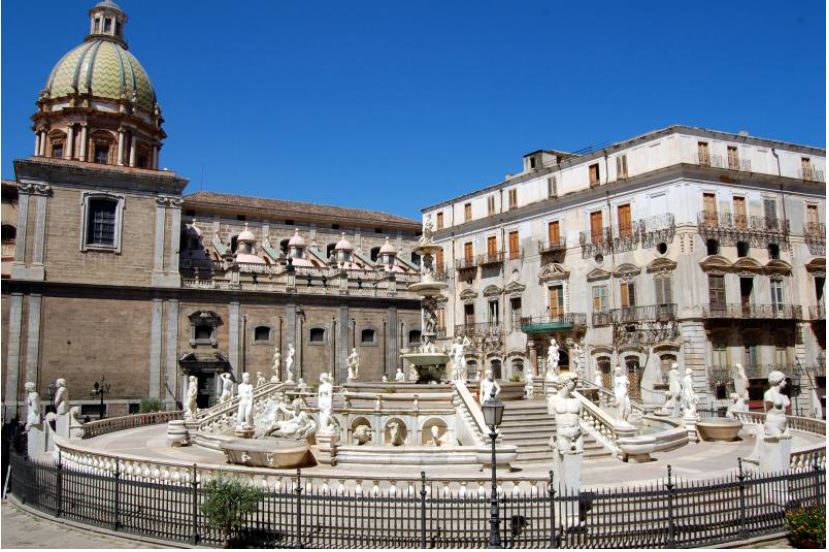
The very first images feature a panoramic view from above of the octagonal lantern and twisted columns of the bell tower (c. 1690) and the polychrome majolica dome (1724) of the Church of San Giuseppe dei Teatini. The camera then descends to the scenic Pretoria Fountainin the square of that name, with the church of Santa Caterina d'Alessandria in the background.
© Palermo Welcome - Assessorato al Turismo del Comune di Palermo
The fountain, which originally comprised 48 statues, four concentric basins, a bridge and balustrades made of steps, has a history worth telling, as it was sculpted and installed in 1554 by the Florentine Francesco Camilliani, a student of Baccio Bandinelli, for the villa of the Spaniard Luigi Toledo, in Florence. It was sold in 1573 by the Toledo family to the city of Palermo and shipped in 644 pieces to be reassembled by Camilliani's son, Camillo, and Michelangelo Naccherino. The fountain took its current name because of its location in the square of the Palazzo Municipale Pretorio. This makes it less surprising that the statues remaining in Florence, now housed in the Bargello Museum, include personifications of the Tuscan rivers Arno and Mugnone. When adapting it to its new home, the statue of Bacchus became the Genius of Palermo. The four basins on the first level were sculpted with the rivers of Palermo (Oreto, Papireto, Gabriele, Maredolce), and the 19th-century gate by Giovan Battista Filippo Basile was engraved with the faces of the Genius of Palermo, Saint Rosalia, and the Praetorian Eagle.Around the city, however, it was nicknamed the "Fountain of Shame", both on account of the huge sum spent to bring it to Palermo and for the nude statues, while in the midst of the Counter-Reformation.
Yet it was precisely its Florentine origin that earned the work and its creator the praise of Giorgio Vasari, whose Lives, published in 1550 and 1568, did not have time to include its transfer (completed on May 26, 1574, a month after the death of the famous artist and man of letters, June 27). Vasari described it as "[a] most stupendous fountain that Signor Don Luigi di Tolledo had made for his garden in Florence; the ornaments around it are various statues of men and animals in various styles […] all the architecture and ornaments of that garden are the work of Francesco […] who has no equal in Florence, nor perhaps in Italy: and the principal fountain, which is still being completed, will be the richest and most sumptuous that can be seen anywhere" (Lives, 1568, VI, 10-22).
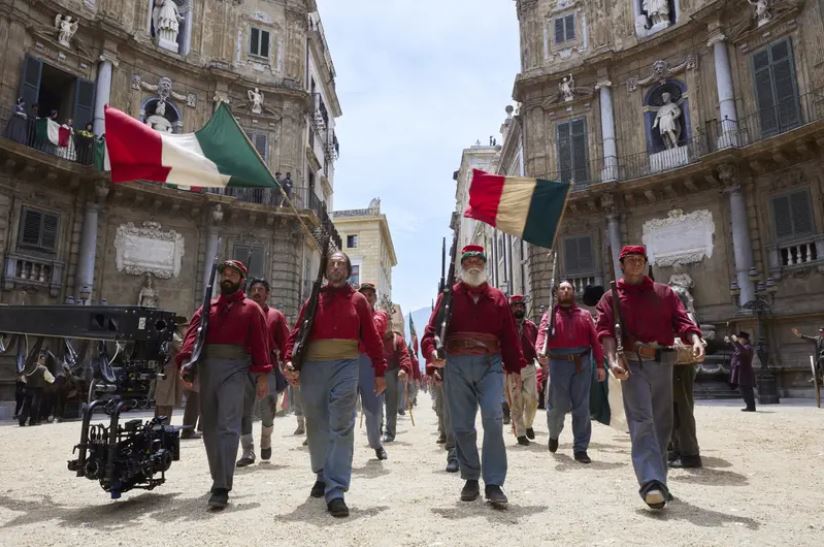
Located a stone's throw from the fountain is another prominent location used in the series, which stands at the city's most famous intersection - Via Vittorio Emanuele and Via Maqueda: the Quattro Canti of Piazza Villena, also known as the Octagon of the Sun or Theatre of the Sun, a Sicilian Baroque urban masterpiece designed by the Florentine Giulio Lasso and completed by Mariano Smeriglio of Palermo. Built between 1609 and 1620, the project was inspired by the intersection of Via Quattro Fontane, conceived in Rome as part of the urban planning commissioned by Pope Sixtus V (1585-1590) for the Jubilee of 1600.
The decorative elements on the facades of the four buildings overlooking the square are divided into four levels by sill courses. The attic levels are decorated with large royal, senatorial, and viceregal coats of arms, while Corinthian pilasters, Ionic, and Doric columns frame the statues of the city's patron saints (Agata, Ninfa, Oliva, and Cristina) before the advent of Saint Rosalia in 1624; the Habsburg emperors (Charles V, Philip II, Philip III, Philip IV); and the rivers of the ancient city (Oreto, Kemonia, Pannaria, Papireto)on the lower levels, beneath which are the basins.
From here, Via Maqueda leads past the aforementioned Pretoria Fountain and Church of the Teatini to Piazza Bellini and another key location in the series, one of the city's great medieval landmarks: the mid-12th century Church of San Cataldo, whose iconic three aligned red domes offer a rare example of Arab-Norman architecture.
The building is adjacent to the equally famous Santa Maria dell'Ammiraglia, commissioned in 1143 by George of Antioch, admiral under King Roger II, where the convent of Benedictine nuns founded in 1194 by Goffredo and Eloisa Martorana gave rise to the name by which the church is still more commonly known today: the Martorana.
Interestingly: the Benedictine nuns in the convent are responsible for the production of marzipan fruit, a tradition which began in the 13th century and is still known today as Frutta Martorana.
© Palermo Welcome - Assessorato al Turismo del Comune di Palermo
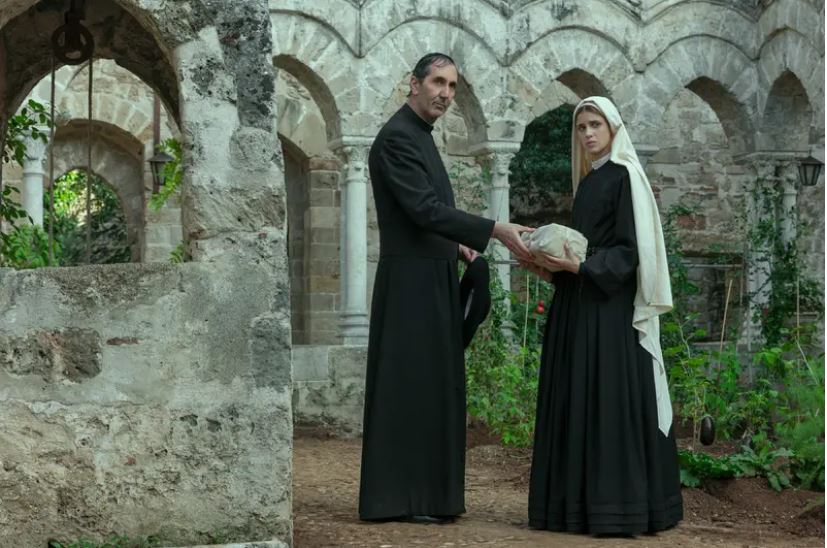
The screencity also features an even more curious short circuit between locations, as here and in the adjacent Church of the Teatini, the exteriors in Ep. 1 evoke the Convent of the Sacred Redeemer, where Concetta (Benedetta Porcari) is at the beginning of the novel, and where she returns after the disappointment of Tancredi (Saul Nanni)’s marriage to Angelica (Deva Cassel). In reality, however, the church interior is the Church of Santa Maria dell'Orto, in Trastevere, Rome, with a large Marian M on the back window. In Eps 3 & 4, Concetta and others walk through a cloister whose pointed arches are supported by twin columns beneath red domes, while these are those of San Cataldo with the Church of the Martorana visible alongside, the cloister itself is the 12th-13th century cloister of San Giovanni degli Eremiti, with its lush vegetation and distinctive Norman-era well, located on the site of an earlier Arab cistern.
The novel mentions another Benedictine monastery, founded by the Blessed Corbera, a Salina forebearwhich appears in Ep.3. This is actually the Abbey of San Sebastiano, Alatri, a place historically connected to Saint Benedict of Norcia who stopped there while travelling from Subiaco to Montecassino (528). The exterior is seenin the sequence ofthe arrival of the carriage carrying the Salinas and Father Pirrone (Paolo Calabresi), and in the beautiful Romanesque cloister with the fountain, where Don Fabrizio converses with the Mother Superior.
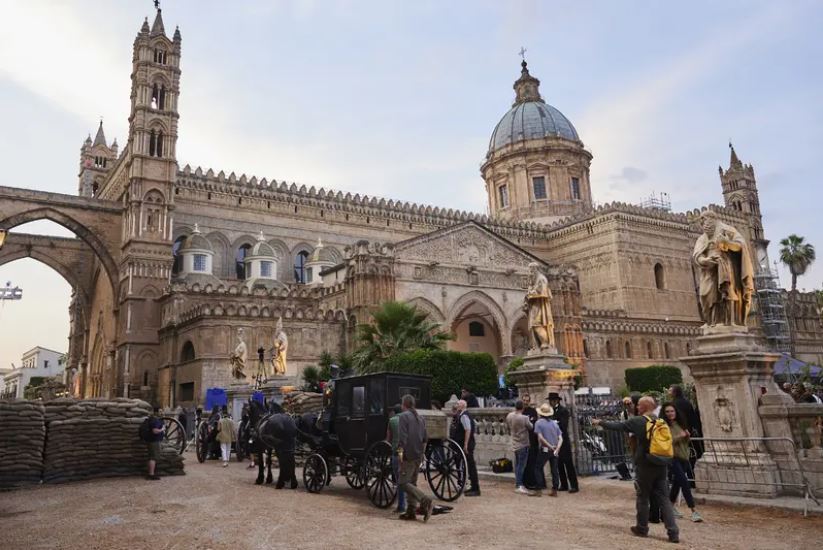
The city’s imposing Cathedral of the Assumption cannot be overlooked; from the section facing Via Vittorio Emanuele continuing on to Via Matteo Bonello, dominated by two 12th-century Norman arched bridges, once Gothic, which connect the church to the bell tower (now neo-Gothic, rebuilt by Emmanuele Palazzotto in 1835-40 after damage from the 1823 earthquake), built on one of the towers of the ancient Punic-Roman walls.
Palermo is "interpreted" by other cities at various times, e.g. the Church of Santa Maria dell'Orto in Rome. This is the case of the Liberation Ball, with Palermitan nobles and Garibaldi's conquerors, which takes place in the great Orchestra Hall of Palazzo Biscari, Catania. The large room is a splendid example of Neapolitan Rococo, decorated with views of Naples over the doors, and a ceiling fresco depicting the Council of the Gods celebrating the glory of the Biscari family. A distinctive feature of the ceiling is its extension into an oval gallery with a balustrade, once reserved for musicians, who in Ep. 2 are actually stationed there to play for the ball.
© Palermo Welcome - Assessorato al Turismo del Comune di Palermo
An even more striking example is the wedding between Angelica and Tancredi, in Ep. 4, which is set in Palermo but was actually filmed in Rome, in the Church of Santi Nomi di Gesù e Maria, as the altarpiece of the Coronation of the Virgin by Giacinto Brandi (1680) and the distinctive large marble groups indicate (thanks to Dr. Ludovica Annesi for the tip).
The Leopard, however, features not only Palermo and its surroundings, as represented by the residences of the Corbera, Princes of Salina by Villa Salina and Donnafugata, but also Turin, the new capital of the Kingdom of Italy... this leaves many more locations to identify and describe in the next two parts of this in-depth study.
Read the other parts of this in-dept analysis:
2. Art at the service of Villa Salina and Donna Fugata in the tv series 'The Leopard'