Forgery in the art world: the works reproduced in 'The Big Fake’
ART AND LOCATIONS: CINEMA IN DETAIL
Stefano Lodovichi's The Big Fake, based on Nicola Biondo and Massimo Veneziani’s ‘Il Falsario di Stato' (2008) opens in Rome in the late 1970s, around the time of the kidnapping and murder of Aldo Moro (1978).
Piazza Navona, the Synagogue, the EUR Lake, non-Catholic cemetery and the banks of the Lungotevere are too prominent in the film to warrant in-depth analysis, and so "Art and Locations" will look primarily at the former focus in its title, discussing some of the paintings reproduced by the film’s main character.
Focussing on the life of Italian forger and mafia criminal Antonio Chichiarelli, the film invokes several great artists and some of their works. These are brought to the big screen, only superficially addressing the issue of their reproducibility (which Chichiarelli’s skill makes quick and easy); their sale as originals is never questioned.
Toni (Pietro Castellitto) is discovered by gallery owner Donata (Giulia Michelini) when she accidentally finds a copy of Gian Lorenzo Bernini’s self-portrait in his room. Captivated by it, she encourages him to continue with what could prove an incredibly profitable business.
Where is this painting, the first famous work we see Toni copy, in real life? It's difficult to say, as several iterations exist, none of which bear any resemblance to the one included in the film, although, inexplicably, Donata does not doubt for a moment that it is Bernini's face.
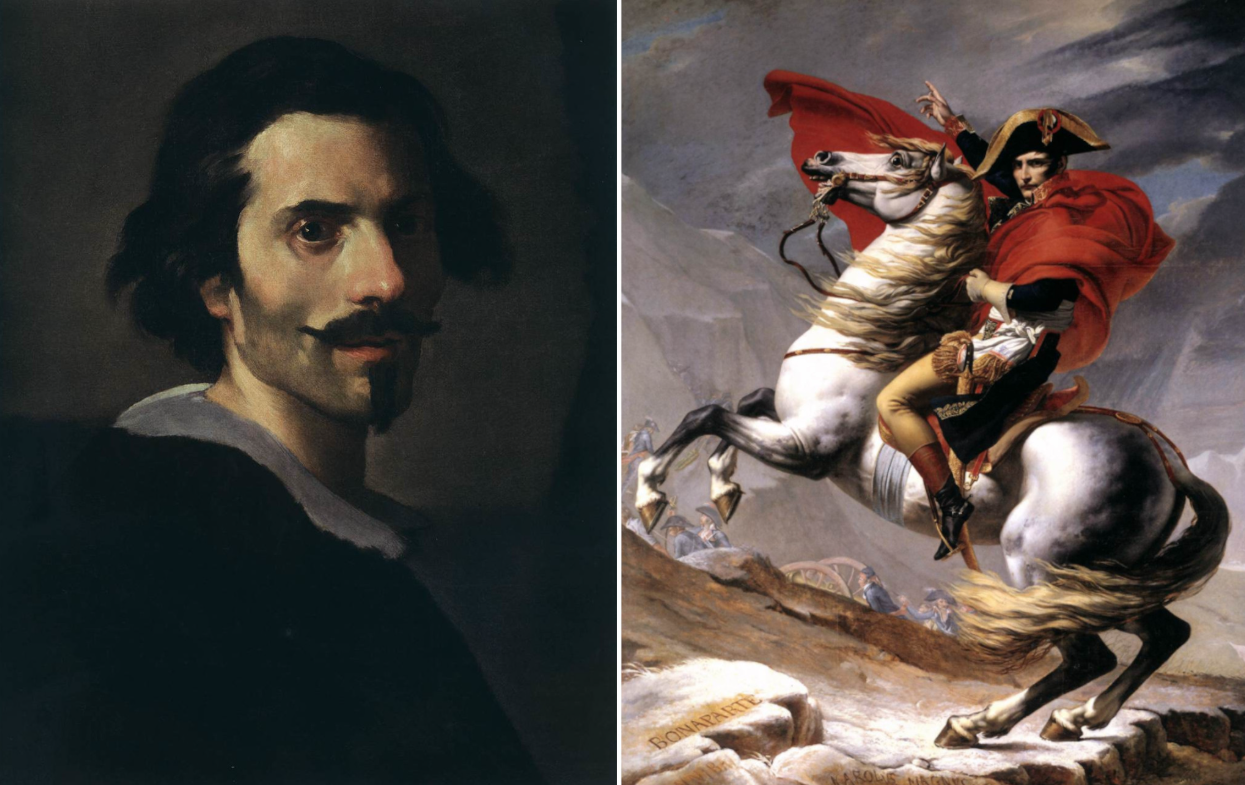
Bernini, Self-Portrait, Rome, Galleria Borghese; J.L. David, Napoleon crossing the Alps,
Château de la Malmaison - © Web Gallery of Art
While there is a self-portrait in the Uffizi, Florence and another in a private collection, the most famous are in Rome at the Galleria Borghese, where the collection amassed in the early 17th century by Scipione Caffarelli Borghese, assisted in part by the position of his uncle, Pope Paul V (1605-1621), has grown over the centuries. Two self-portraits by the artist - the focus of a recent exhibition at Palazzo Barberini (Bernini e i Barberini, February 12 - June 14, 2026) - were acquired in the early 1900s: in 1911, Baron Otto Messinger donated one painted in his late forties with a moustache and goatee; while the other, which portrays him at 25 years old with an expression both sharp and surprised, was purchased in 1919 from Alvise De Ruggeri.
Donata commissions Toni to make a copy of Amedeo Modigliani's Portrait of Paulette Jourdain. Unlike the Bernini self-portrait, this work is immediately recognizable: Modigliani’s portrait of the family maid (1919) of Leopold Zborowski, the Polish poet and art dealer who supported the Livorno-born painter in the final years of his life, between 1916 and 1920.
It was auctioned by Sotheby's in New York in November 2015 for approximately $43 million and is now part of the Hermanos Collection in the city.
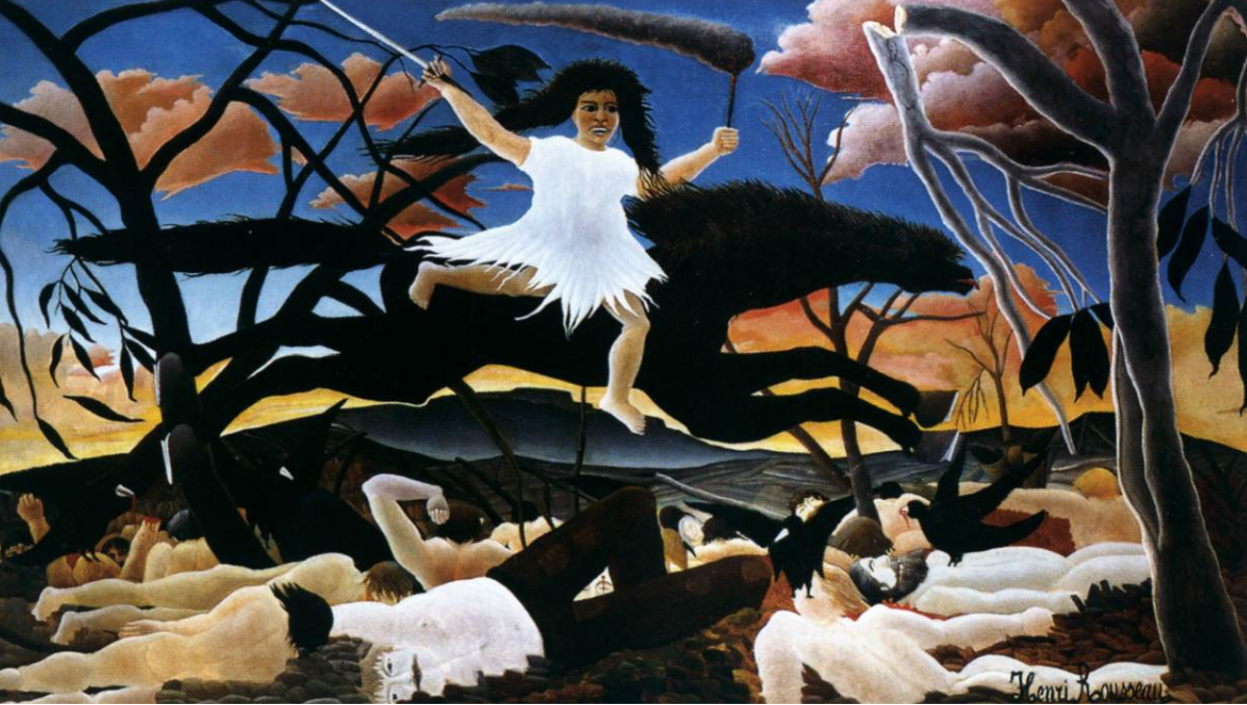
Henri Rousseau, Guerra, Parigi, Musée d'Orsay - © Web Gallery of Art
The third painting brought into particular focus is commissioned by Zù Pippo (Fabrizio Ferracane), associate and intermediary for the criminal organization Banda della Magliana through whom he comes into contact with Toni. Channellingthe classic self-aggrandizement of the average mafioso, he wants a copy of Napoleon Crossing the Alps by Jacques-Louis David (1800-1803), archetype of the modern propaganda portrait, even if its first version was requested by Charles IV of Spain when he was seeking an alliance with the French Republic.
We watch Toni create the large canvas (260x221 cm), drawing inside the preparatory grid, and the finishedversion on the day of its presentation, accompanied by a dazzling celebration. This version, housed at the Musée National du Château de la Malmaison, 15 km west of Paris, celebrates Napoleon astride his beloved horse, Marengo, about to cross the pass that will lead him and his army to asecond victorious Italian campaign.
Ironically for a film about copies and forgeries, there are four different versions of the painting by David himself: in the Palace of Versailles (two); the Charlottenburg Palace in Berlin; and the Museum of the Belvedere Palace, Vienna.
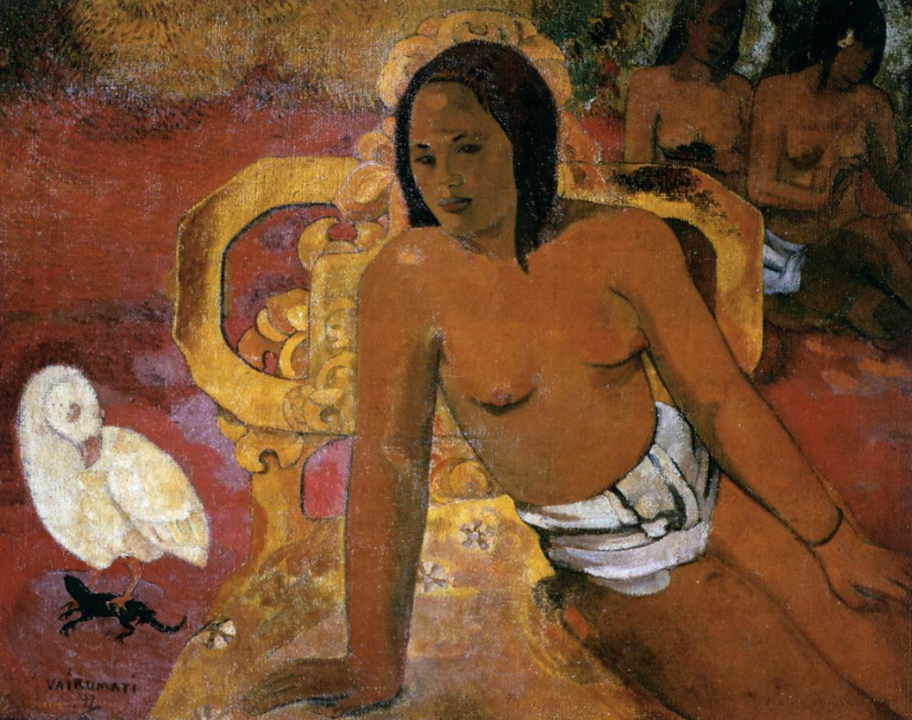
We also see Pietro Castellitto’s character reproducing War, one of Henri "Le Douanier" Rousseau’s most famous works (1894, Paris, Musée d'Orsay), and on Arearea and Vairumati, two of Paul Gauguin's Tahitian paintings (1892 | 1897, Paris, Musée d'Orsay), but, then again, "Gauguin is easy," he tells Donata. He also copies one of Monet's Water Lilies; Toulouse-Lautrec’s The Divan (1893, São Paulo, Brazil, Museu de Arte); The Street Enters the House by Umberto Boccioni (1911), a cornerstone of the Futurist movement; and Robert Delaunay's Solar Discs (1914, Basel, Kunstmuseum), with its propeller and Eiffel Tower, which Toni rightly calls avant-garde painting.
These are just a few of the many master pieces that Toni claims to be able to reproduce without a flaw...