Martone's Rome in 'Fuori': monumentalism and historic venues
ART AND LOCATIONS: CINEMA IN DETAIL
In the 1983 interview with Enzo Biagi that Mario Martone edited over the closing credits of his film (link at the end of this article), Goliarda Sapienza said "prison is like the outside". She explained the idea that prison is a cross-section of society, not dissimilar to society itself, marginalizing the most imaginative individuals and those most in need of emotional support. It was no coincidence that Sapienza published the novel L'Università di Rebibbia that same year.
Parioli
The places in Rome where Goliarda Sapienza spent those years represented her desire for freedom, captured perfectly by the director of 'Fuori'. The city also contains within its walls the elements that protect and confine, starting from a place of welcome in Parioli, the neighborhood where Goliarda lived. Martone used the apartment where Goliarda (Valeria Golino) lived on Via Denza in the film, he also focuses on Piazza Euclide several times. In a bar here, Goliarda meets Roberta (Matilda De Angelis), across from the imposing travertine mass of the Basilica of the Sacred Immaculate Heart of Mary, designed by Armando Brasini (1923). During the twenty years of Fascism, Brasini, a Roman architect, was sponsored by Margherita Sarfatti, Mussolini’s lover, whose cultured circle of artists and intellectuals features in Joe Wright's recent series M - Son of the Century (where she is played by Barbara Chichiarelli). Although Brasini was eventually lost out to Marcello Piacentini's Rationalism, his style of “monumentalism” is a feature in the collective imagination of the time, from the church in Piazza Euclide to iconic buildings such as the government building on the Taranto seafront, and the INAIL building on Via IV Novembre in Rome. Also in Rome is his Ponte Flaminio or "bridge of the eagles" which for film buffs is the bridge that Nanni Moretti drives over on his Vespa in Caro Diario (1993), reflecting: "I may be sick, but I love this bridge, I have to drive over it at least twice a day."
Other squares and a surprise
In addition to Piazza Euclide, Martone's film features several other Roman squares, including Piazza di Porta Maggiore where Roberta is captivated by the words "the hours of our present are already legend" on the Aurelian Walls; Piazza del Popolo; and Piazza dell'Indipendenza, outside Termini station.
Scenes featuring Goliarda/Valeria Golino and Roberta/Matilda De Angelis were shot in several historic venues in two of these locations. In Piazza del Popolo - the square which marks the northern boundary of Rome's historic centre - they sit outside at number 16, Caffè Canova, designed by Enrico Del Debbio between 1952 and 53. From Piazza dei Cinquecento, they go into Termini station and head upstairs to the Sicilian pastry shop Dagnino. The set designers have played with the locations here: on the screen, the shop patrons can see the train timetables, but it is actually located in nearby Piazza della Repubblica, inside Galleria Esedra.
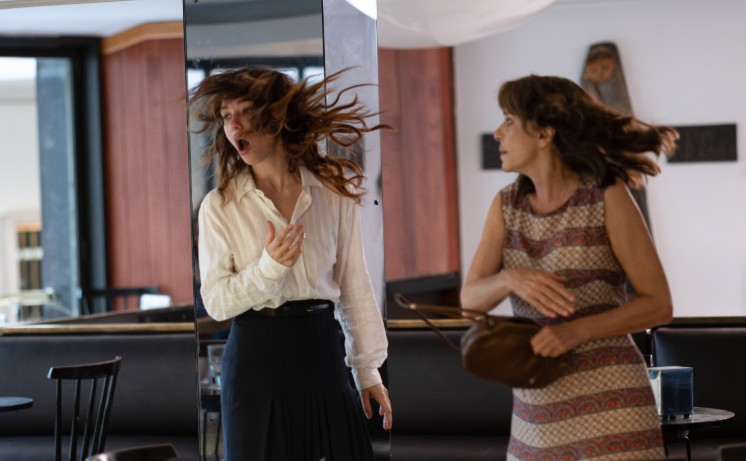
The protagonists on the upper floor of Dagnino - © Mario Spada
Dagnino has retained its 1950s "artistic" charm, having remained unchanged since its opening in 1955. The tea-room features mirrors painted with figures of peasant women working in the fields by Agrigento painter Alfonso Amorelli, and wooden sculptures symbolizing the cities of Sicily by Bolognese artist Giovanni Maria Manganelli; while the main rooms feature abstract works by German painter Herta Scheffer, Amorelli's wife.
Watch Enzo Biagi's interview with Goliarda Sapienza (1983):
Read other articles on Art and Locations. Cinema in Detail:
Cinque ville per una: il barocco siciliano e non solo ne 'L'arte della gioia'
Caravaggio sullo schermo tra location ed evocazioni - prima parte
Caravaggio sullo schermo tra location ed evocazioni - seconda parte