Mussolini. Son of the Century: amidst art and design
ART AND LOCATIONS: CINEMA IN DETAIL
In the hope that the superb series, Mussolini. Son of the Century, directed by Joe Wright and recently place at the top of The Hollywood Reporter’s TV rankings for 2025, will have a second season, here’s a look at the locations and the works of art used to create the first eight episodes.
The series, Mussolini. Son of the Century, based on volume one of Antonio Scurati's pentalogy M. Son of the Century, moves from Milan to Rome as it recounts the first five years in the rise to power of Benito Mussolini (an exceptional Luca Marinelli) - from founding the Fasci Italiani di Combattimento (Italian Fasces of Combat or Italian Fighting Bands; March 23, 1919) while editor of Il Popolo d'Italia, to his arrest after the Socialist victory, the March on Rome, and his appointment as Prime Minister, through to the assassination of Matteotti (June 10, 1924). The urban landscapes in the series, especially those of Milan, are transfigured by a surreal and distressing mise-en-scène. Built in the studio, they are of little relevance to this article, as are the homes in Predappio, Forlì and Milan where Rachele Guidi Mussolini (Benedetta Cimatti) lived at the time which feature here as anonymous spaces.
The focus of this article is rather on the interiors, the palaces of power and private apartments, starting with the scenic and artistic masterpiece that is the apartment of Margherita Sarfatti (Barbara Chichiarelli), Venetian art critic from a wealthy Jewish family and the Duce’s lover.
Several scenes are set in this prestigious cultural salon (historically located on corso Venezia, Milan), including parties with guests like Filippo Tommaso Marinetti (Stefano Cenci), where Mussolini himself was "challenged" for his questionable violin skills. The main setting is a celebration of “Wiener Werkstätte” ("Vienna workshop", 1903-1932), an association of artisan-alchemists who transformed design into an act of revolt in the early 1900s.
Production designer Mauro Vanzati went beyond reality, because Sarfatti's home was actually nothing like what he has created: floors, wallpaper, and black and white sofas, patterned with diamonds, leaves, and fake craquelure effects, dominate the space.
The patterns draw on the ideas of Josef Hoffmann, one of the founders of the Wiener Werkstätte (another was Koloman Moser), who hated curved lines, being instead obsessed with vertical and orthogonal lines that create meanders, labyrinths, and checkerboards. The result is a fascinating room that magnificently manages to simultaneously disorient and hypnotise the viewer whose gaze is lost in those graphic tangles.
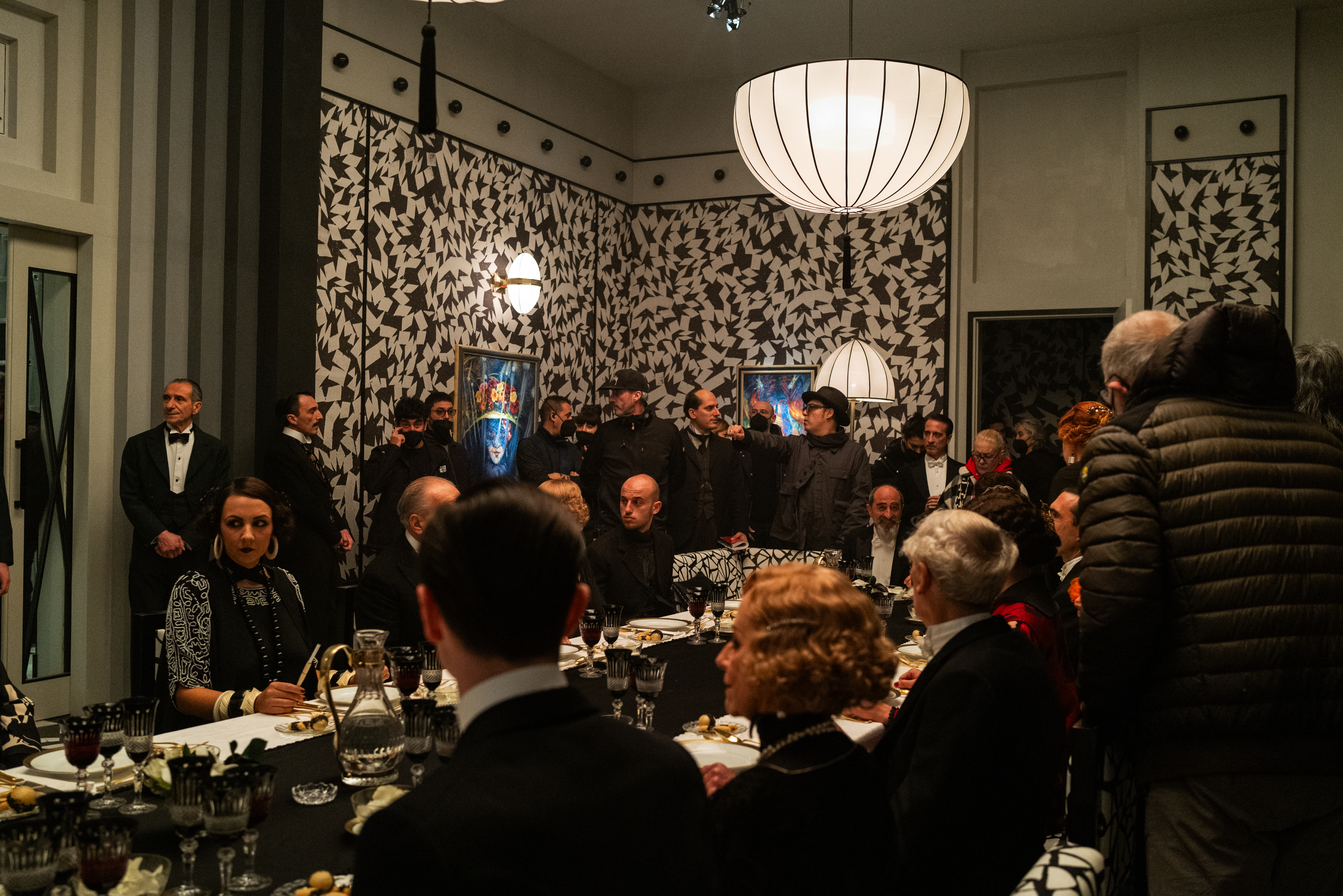
Paintings and sculptures scattered throughout the set complete the décor in the second episode. As Marinetti recites The Battle of Adrianople, repeating obsessively "flames, flames, flames" about bombs and explosions, we are offered the glimpse of a marble sculpture on the table that resembles a stylized bird, which is very similar to Constantin Brancusi's famous Maiastra (New York, MoMA, 1912), albeit with a longer neck.
Vanzati's extraordinary work extends to the walls where there are at least three Futurist paintings amidst the various on show: Umberto Boccioni's Modern Idol (London, Estorick Collection of Modern Italian Art, 1911) and Luigi Russolo's Tina's Hair (1906), both presented in 1911 at the first Futurist group exhibition, the Esposizione d'arte libera, held at the former Ricordi factory in Milan – and already linked in contemporary catalogues. Then, above a table, which later features two permanently lit menorahs, hangs Gerardo Dottori's Gialli-Violetti (1923). The painting, recently exhibited in 2017 at the Accorsi-Ometto Museum of Decorative Arts in Turin, raises some questions here: it is possibly hung upside down, as it shown differently in the Perugian painter's catalogues, a common mistake with abstract paintings.
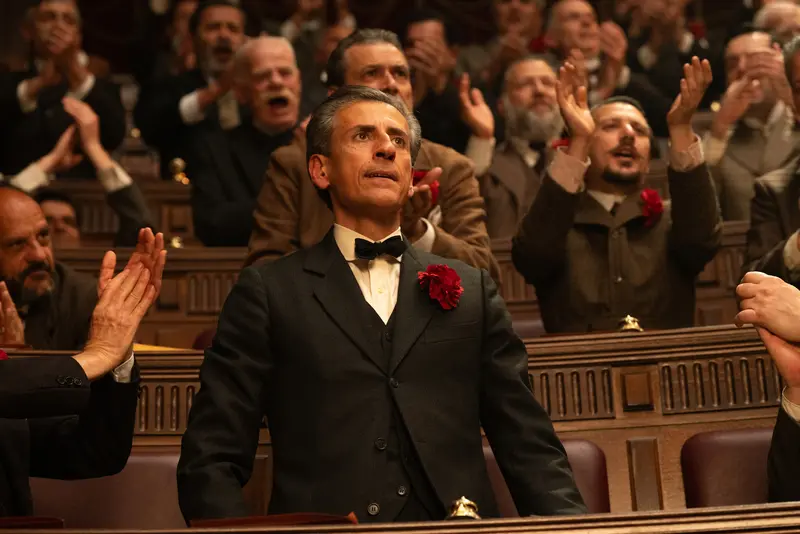
Gaetano Bruno interpreta Giacomo Matteotti - © Andrea Pirrello
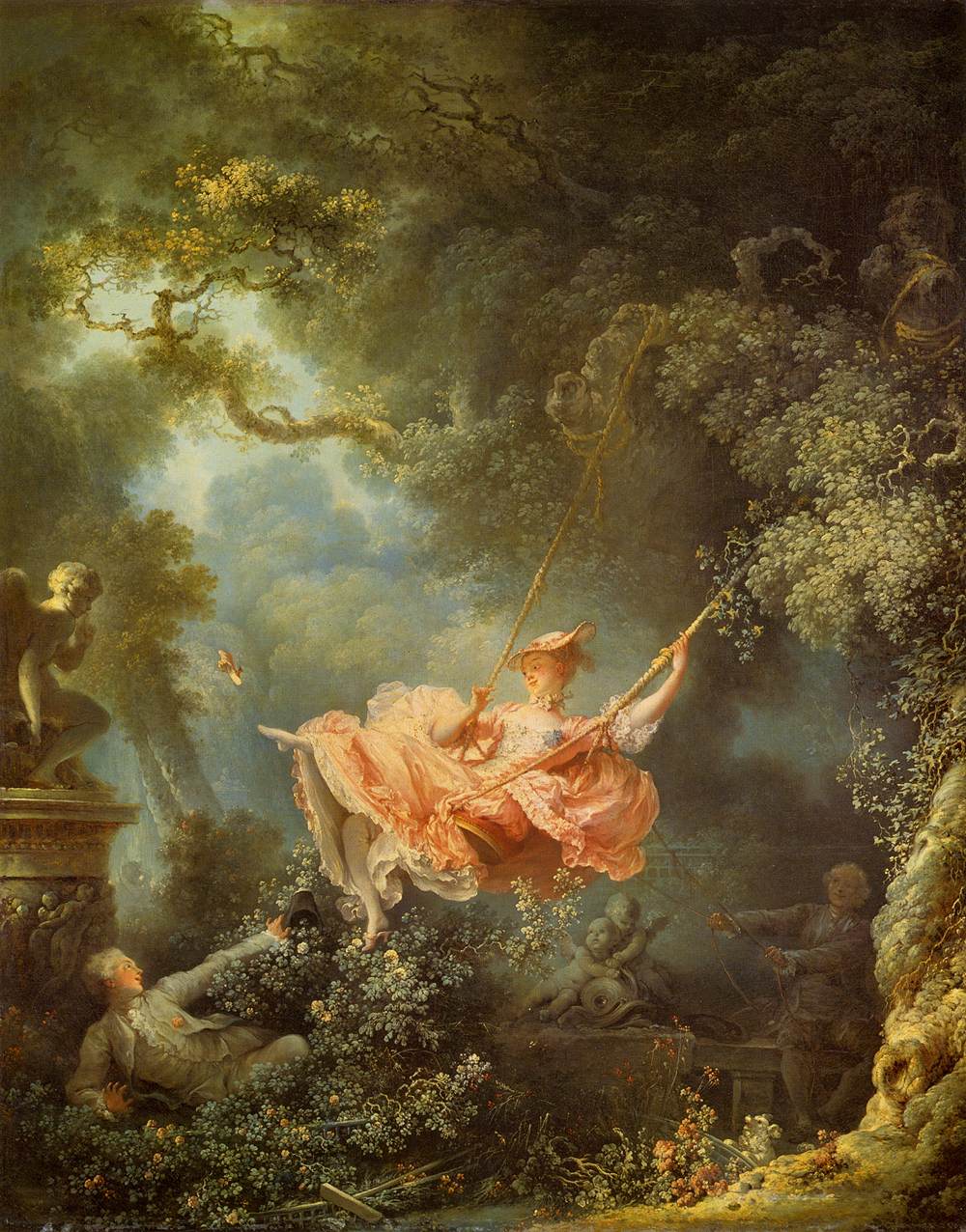
The set design of Mussolini's private apartment included two 18th-century Rococo paintings. An early episode features François Boucher's The Toilet of Venus (New York, Metropolitan Museum, 1751), commissioned by Madame Pompadour for her most prestigious lover, Louis XV. The original artwork is vertical, but appears horizontal here as only the central part has been used in the frame. Another famous masterpiece appears in the opening of episode 5, hanging above the sofa where Mussolini is seated: Jean-Honoré Fragonard's The Swing (London, Wallace Collection, 1767) reveals an unwitting love triangle, as a lady is pushed on a swing by her husband, watched from the opposite side by her lover (it is no coincidence that the painting is also known as The Happy Accidents of the Swing).
Episode 4 provides some very interesting locations, starting with an evening at Teatro San Carlo in Naples, where Mussolini attended Giacomo Puccini's Madame Butterfly on October 24, 1922, which features the theatre boxes and stage curtain depicting Parnassus, created in 1854 by Giuseppe Mancinelli, director of the School of Drawing at the Istituto di Belle Arti.
These are the days that immediately preceded the March on Rome, when the Blackshirts violence unfolded. The Blackshirts gather in the open countryside shouting "Whose is the victory? It’s ours!" with a backdrop of ancient structures, the Parco degli Acquedotti in Rome. Following this, they burst into unruly shouting as they use Palazzo Farnese in Caprarola as a monumental urinal, mocked with Mephistophelian ritual.
And here, our curiosity is provoked: in this scene, the façade designed by Jacopo Barozzi da Vignola for Alessandro Farnese the Younger, nephew of Paul III, appears to have been modified, with the double flight of stairs followed by a curved balustraded wall that doesn’t actually exist! Is this a modification made by CGI, as Mauro Vanzati revealed us.
In the same episode, Donna Rachele takes refuge in prayer in Milan, but the Baroque altar adorned with golden rays where she kneels is actually that of the Church of Santa Maria in Portico in Campitelli, Rome; whose reconstruction was commissioned of Carlo Rainaldi (1661-1667) by Pope Alexander VII to give thanks for the end of the plague of 1656.
Given the subject of the series, places of power naturally play a particularly important role within this narrative and so deserve specific attention…