The real Rome in Paolo Sorrentino's 'La grazia'
ART AND LOCATIONS: CINEMA IN DETAIL
After exploring the Turin locations that stood in for Rome, it’s time for a closer look at those locations that truly represent the city of Rome, even if not always in their usual roles. As previously mentioned (link part I), the balustraded walkway between the turrets atop the façade of Villa Medici - designed c. 1576 by Bartolomeo Ammannati for Cardinal Ferdinando de' Medici (1549-1609) - was used as the terrace of the Quirinale Palace, a place of reflection for President Mariano de Santis, played by Toni Servillo (as seen at the start of the trailer below). Various shots of the actor smoking as he walks reveal locations in the backgroundthat include, depending on the direction, Villa Malta delle Rose on Pincio, St. Peter's Basilica, the Monument to Vittorio Emanuele II.
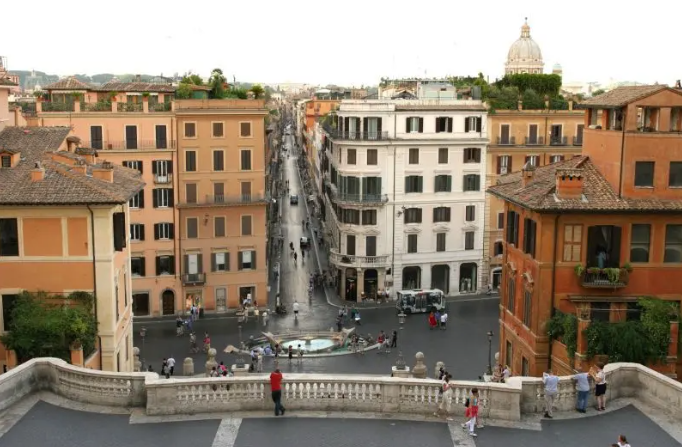
The real Quirinale Palace is seen from the outside only in one of the final scenes, when the outgoing President starts to walk from Piazza del Quirinale to his apartment in Piazza di Spagna. Mariano de Santis passes along Via dei Condotti (named for the pipes installed by Pope Sixtus V (1585-1590) to bring water from the Aqueduct Felice to the city), walking all the way to the Spanish Steps, built by Roman architect Francesco De Sanctis (1723-1726). The project solved the age-old problem of the arduous climb that connected the Spanish side of the city below, to the French side above, an area which comprises the Church of the SS. Trinitàdei Monti, one of Rome's five French-speaking churches, and the French Academy, housed in the aforementioned Villa Medici.
A scene in perfect Sorrentino-style, with a nod at the irreverent energy of The Young Pope and The New Pope, shows an African Pope weaving his way through the Vatican gardens on a scooter. He drives off after a conversation with Mariano about the new euthanasia laws, which actually takes place on a staircase in Rome's Botanical Gardens where, beyond a gate, the Nymphaeum of Cornelius Cornutus(1736-1755) is visible. This was designed by the Florentine architect Ferdinando Fuga, hired by the Corsini family in the early 1700s to make modifications to the Villa and Palace which included enlarging and adding the grand monumental staircase. When Tommaso Corsini sold the property to the Kingdom of Italy in 1883, the Palace became the seat of the Accademia deiLincei and would later house the city's first state museum (Galleria Corsini), while the garden, excluding the section on the slopes of the Janiculum Hill, became the Botanical Gardens, which explains the fence that today divides the two sections.
The Church of Sant'Agata dei Goti, inthe neighbourhood of Monti is the setting for the flashback of the funeral of Aurora, Mariano's wife. The church's features include an important 12th-century Cosmatesque ciborium and a fresco of the Glory of Saint Agatha by Paolo Gismondi (1636) in the apse, which replaced a previous 5th-century mosaic of Christ the Judge after the apse collapsed.
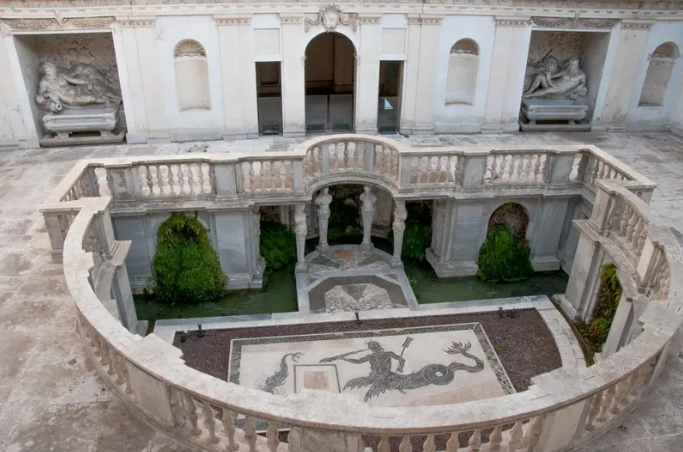
However, once again, it is sixteenth-century Mannerism that proves most congenial to Paolo Sorrentino. In addition to Villa Medici, he used another structure designed by Bartolomeo Ammannati, the Nymphaeum of Villa Giulia, built for Pope Julius III Ciocchi dal Monte (1550-1555). Sorrentino stages a surreal dinner here, featuringthe President, his daughter Dorotea, and Coco Valori (Milvia Marigliano), an eccentric art critic who is his close friend since high school. The dining table is placed at the centre of the semicircle ofcaryatids on the lower level of the nymphaeum, whose upper balcony holdsFountains personifying the Tiber and Arno rivers where Coco Valori pauses, as Doroteaaccompanies her to the exit.
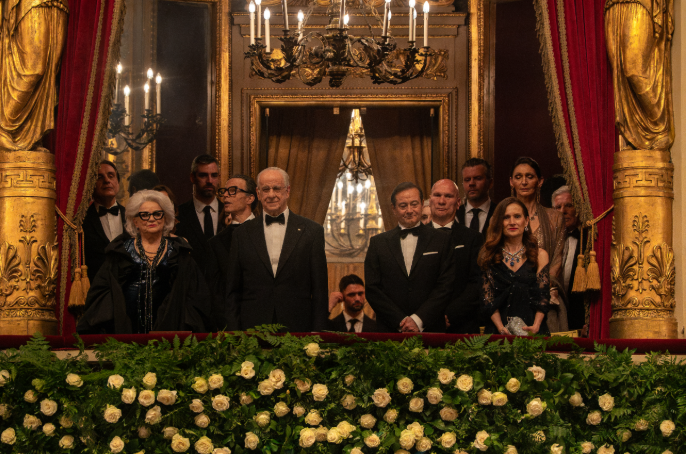
While the locations of La grazia are dominantly Turin and Rome, there are also brief glimpses of other Italian regions. The rows of trees in the fog are in the countryside outside Modena, in Emilia Romagna: places of the soul and memory for the president, who recalls his childhood there and meeting his beloved wife, Aurora. A brief sequence takes place at Teatro alla Scala in Milan: Mariano De Santis and his close staides appear in the Crown Box (since 1861, the Royal Box),designed by Giuseppe Piermarchio with rich gilded carvings and caryatids with high capitals, which hosted Archduke Ferdinand, Governor of Lombardy and son of Empress Maria Theresa of Austria, on 3 August 1778, at the theatre's inauguration.
The first part of 'Art and Location' on La grazia:
An unusually Turinese Rome in Paolo Sorrentino's 'La grazia'