Nolan's Odyssey: the intersection of cinema and iconography
ART AND LOCATIONS: CINEMA IN DETAIL
Christopher Nolan's The Odyssey offers a wide range of interpretations, ranging from the technical, the decision to shoot entirely in IMAX 70mm, to the strictly cinematic, as his dazzling direction makes the nearly three hours a feast for the eyes (and ears, given the wonderful sound); from the philosophical, as Odysseus’ journey marks the end of an era, to the literary, with the selection of episodes from the twenty-four books of Homer's epic poem.
In this Art and Location column, we will delve into the links with art history and a range of visual and iconographic references, and explore some key differences between the traditional telling of some episodes and their rendering in the recently released film.
To be clear, Nolan's monumental work, a modern peplum (sword and sandals genre movie), features only one work of art in its almost three hours running time: a large statue of Athena in her temple in Troy. Her form and robe with its parallel lines of drapery are clearly reminiscent of 7th-6th century BC Ionic sculpture and masterpieces such as the famous Hera of Samos (Paris, Musée du Louvre), which is headless, as the fictional statue of Athena will be after Troy’s defeat.
No notable artefact is featured, and the only other "art objects" that could be considered such are the Trojan Horse, a decidedly modern and untraditional take, and the brooch of Athena that Penelope gives Odysseus before he leaves for the war, another reference to Ionic sculpture and the protagonist's protector.
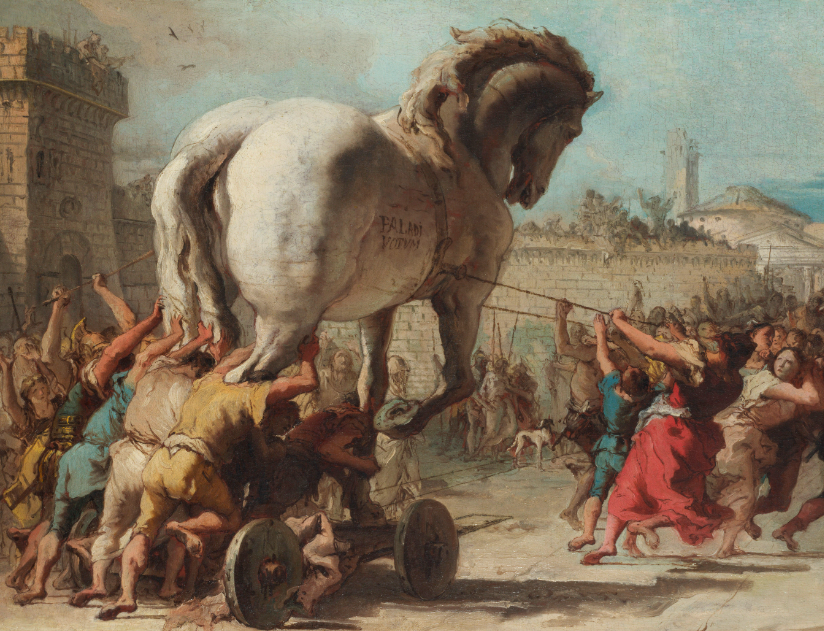
Londra, National Gallery - © Web Gallery of Art
Some important details in the film's imagery, however, seem borrowed from cinematic tradition, with references ranging beyond previous versions of The Odyssey. Among these, the beautiful image of the Trojan Horse on the seashore is memorable; half-buried in the sand, it recalls the Statue of Liberty in one of the most memorable shots of the dystopian future in Franklin J. Schaffner's Planet of the Apes (1968). This detail becomes all the more significant when delving deeper into the literary aspect because the source for the story is not the Odyssey, but Virgil's Aeneid Book II, where Aeneas tells Dido how the horse was dragged into the city on wheels, with no reference to it being buried in the sand. There is no sand burial either in previous films about the Odyssey, such as Troy (Petersen 2004), or in art-historical iconography, such as Giandomenico Tiepolo’s beautiful painting (1760), now in the National Gallery in London.
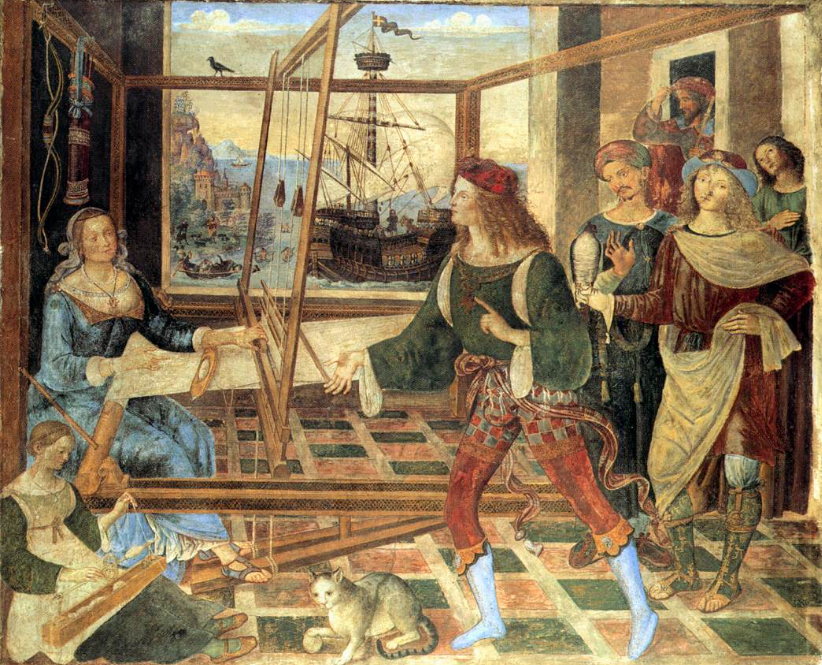
(from Siena, Palazzo del Magnifico) - © Web Gallery of Art
A defining theme in the story is Penelope's work at the loom: every night she unpicks the weave worked during the day to delay the question of marriage to any of the suitors and to extend her wait for her husband’s return.
Nolan makes no reference to the function of the weave, although he shows Anne Hathaway, who plays the queen of Ithaca, working on the vertical loom more than once. The detail evokes historical and artistic references, most immediately Pinturicchio's fresco, painted in 1509 for Pandolfo Petrucci in Palazzo del Magnifico in Siena (now in London’s National Gallery). It also evokes Diego Velázquez's The Spinners (Madrid, Prado Museum, 1657), whose subject was subsequently recognized as the challenge between Athena and Arachne who would be punished by the goddess for hubris.
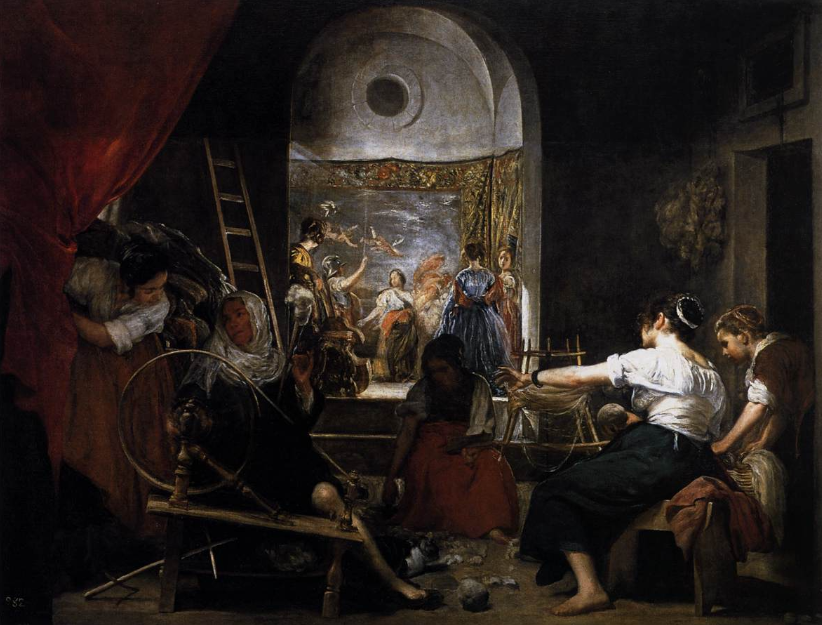
Diego Velázquez, The Spinners (The Myth of Arachne),
Madrid, Prado Museum - © Web Gallery of Art
The thrilling horror sequence set in Polyphemus's cave deserves a separate mention. Hiding in the cave, Odysseus and his men are surprised by the arrival of the Cyclops, son of Poseidon. Nolan produces a tense scene with the mythological monster which succeeds, despite all (or almost all) of the audience knowing the outcome in advance — a detail which Alfred Hitchcock regarded as a prerequisite for suspense, as admirably explained to François Truffaut in the famous book- interview "Cinema According to Hitchcock."
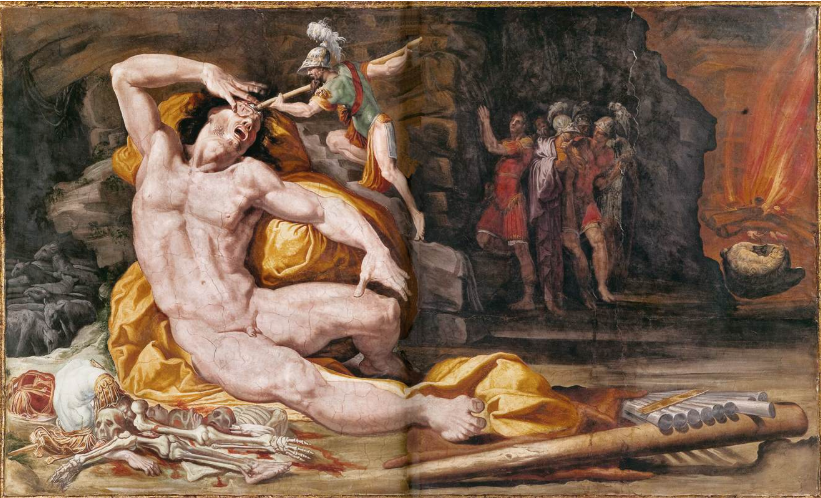
Pellegrino Tibaldi, The Blinding of Polyphemus,
Bologna, Palazzo Poggi – © Web Gallery of Art
Polyphemus’ single eye is vertical, not horizontal, which makes him even more terrifying because it is different to how he is generally depicted. One example is the famous 1st century BC sculptural group, Odysseus blinding Polypohemus, once in a cave in Tiberius's villa in Sperlonga, now in the town’s archaeological museum, and another is the same scene painted in the mid-16th century by Pellegrino Tibaldi for Palazzo Poggi in Bologna. This fresco cycle by the Lombard painter, who trained in Bologna and Rome in the footsteps of the Raphaelesque school, is one of the greatest depictions of the Odyssey in the history of art. It covers the two rooms known as the Hall of Odysseus and the Hall of Polyphemus with iconography entirely dedicated to Homer’s epic. The scenes in the palace of Cardinal Giovanni Poggi (home to the prestigious Alma Mater University of Bologna since 1803) include several moments from the Odyssey: in the first, Odysseus in the presence of Alcinous; Odysseus’ companions taking the herds of the Sun; Zeus shipwrecks Odysseus; Odysseus saved by the nymph Eno; in the second, Neptune and Odysseus ship; Odysseus and the sorceress Circe; The Gift of Aeolus; Blinded Polyphemus searches for Odysseus; Odysseus blinds Polyphemus.
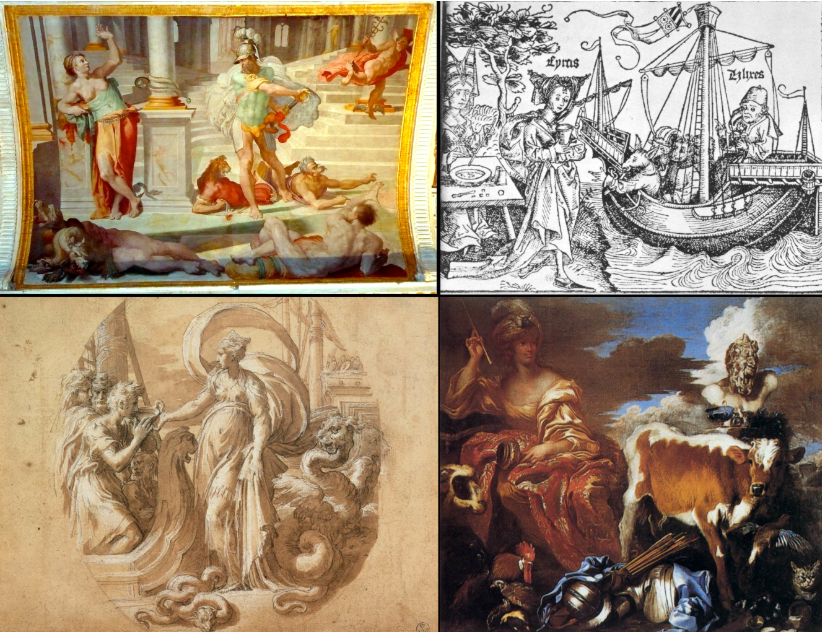
Parmigianino; G.B. Castiglione, Uffizi - © Web Gallery of Art
Comparison of these depictions with the storyline of The Odyssey prompts the reflection that any visual rendering of Homer's poem is really a selection of significant moments, given that Nolan’s mammoth effort includes the episodes with the sorceress Circe and Polyphemus of those in the frescoes.
In the film, the prodigious queen of Aeaea turns Ulysses' men into pigs by reshaping them with her own hands, this earthy, human action which becomes a fantastically horrifying detail on screen is absent from the poem which references the proverbial wand, actually Circe's usual attribute. In the corresponding Bolognese fresco, men in various stages of metamorphosis are depicted around the two protagonists: this beautiful detail which – in a moment when many seem obsessed with philology - demonstrates a reinterpretation of the text, as the three characters are becoming a lion, dog, and dragon, none the pigs of the original epic.
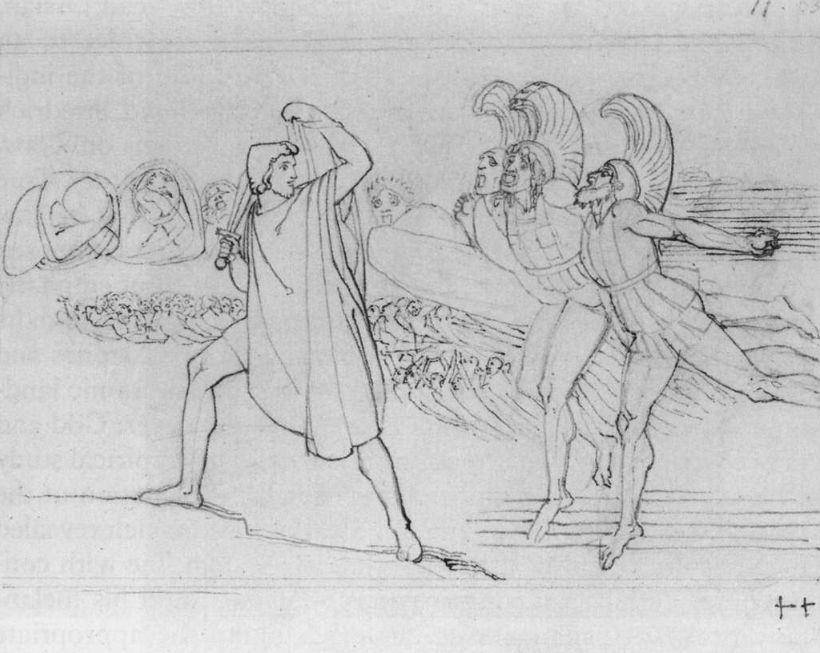
Royal Academy - © Web Gallery of Art
It is also worth analysing Odysseus's encounter with the dead which follows the episode with Circe, made possible thanks to her instructions. The summoning of the dead takes place on the beach, and several Greek heroes appear before him: Agamemnon, and also an enraged Sinon, the man left beside the Trojan Horse and deceived by Odysseus himself. Sinon doesn't appear in this episode of the poem, making this another addition to Nolan's screenplay, one which further heightens the protagonist's gloom. The sequence, set at night and lit by fires, depicts a rush of armoured souls and recalls one of the most famous interpretations of this part of the story. British neoclassical artist, John Flaxman, created 94 plates for Homer’s The Iliad and the Odyssey, which were engraved by Tommaso Piroli and published in Rome by Francesco Romero in 1793. He also illustrated another literary masterpiece, the Divine Comedy. In the image in question, three soldiers run toward Ulysses against a background of flying and desperate souls, wearing agile armour and high crested helmets, a very similar look to those in the film. Who knows, perhaps Nolan took a look at his compatriot’s illustrations from over two centuries ago...
On The Odissey, read also: