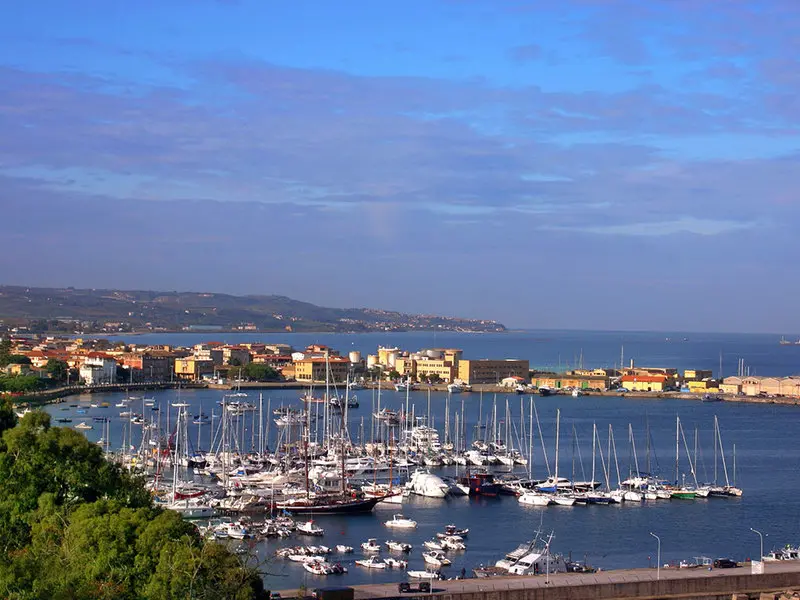
Founded as Hipponion, it became an important city of Magna Graecia. In Roman times the city was renamed Vibo Valentia or Vibonia, while under the Normans it became simply Valentia. It was Monteleone from the late 16th century until 1863, and later Monteleone di Calabria, until 1928 when it was reassigned as Vibo Valentia.
Located on the western side of the Calabrian peninsula, it retains some of the Greek walls and is dominated by the Norman-Swabian castle located on the acropolis of ancient Hipponion.
Locally, a range of archaeological sites celebrate the Greek necropolis in Scrimbia; the Greek temples of Persephone (Doric), the park of Remembrance, and Kore-Persephone-Demeter (Ionic) in Cofino; and the Roman baths and domus in Sant'Aloe.
Noteworthy churches include the 17th century Cathedral of Santa Maria Maggiore and San Leoluca which is Byzantine in origin; the Gothic Church of the Rosary, a Franciscan church built on a Roman theatre; and the Renaissance Church of San Michele, attributed to Baldassarre Peruzzi. Notable secular buildings include Palazzo Romei, built to a design by Leon Battista Alberti, and Palazzo Capalbi, at the foot of the 17th/18th century castle.
All the buildings were significantly renovated following the 1783 earthquake.
The port, in the southern part of the gulf of Santa Eufemia, has one of the largest harbour masters' offices in Italy.
Fondazione Calabria Film Commission
Cittadella Regione Calabria — Località Germaneto — 88100 Catanzaro
Phone: +39 0961 853836
Email: info@calabriafilmcommission.it