Cinema, modern art, and classical culture in Villoresi's Orfeo
Early 20th-century art and classical culture merge in Orfeo, debut film from Virgilio Villoresi, creating a captivating and melancholic atmosphere that contributes to the dreamlike vision of the film which alternates live action with stop-motion animation.
The myth of Orpheus and Eurydice has been revisited countless times over the centuries; from Virgil’s Georgics, in a digression from his discourse on bugonia (concept recently brought to the screens with Yorgos Lanthimos’ film of that title), to the Renaissance play by Angelo Poliziano (Fable of Orpheus, 1479-1480), the cycle of sonnets by Rainer Maria Rilke (Die Sonette an Orpheus, 1922-1923) and Cesare Pavese's L'inconsolabile, one of his The Leucothea Dialogues (1947) through to the most famous of film adaptations, by Jean Cocteau starring Jean Marais (Orphée, 1950).
Villoresi, however, draws inspiration primarily from one of the first graphic novels published in Italy, Poema a fumetti (Poem Strip, 1969) by Dino Buzzati, whose 20th-century milanese setting is recreated in the film. After a concert at the Polypus Theater on Via Saterna, reclusive pianist Orfeo (Luca Vergoni) meets the elusive and captivating ballerina Eura (Giulia Maenza) and falls madly in love with her.
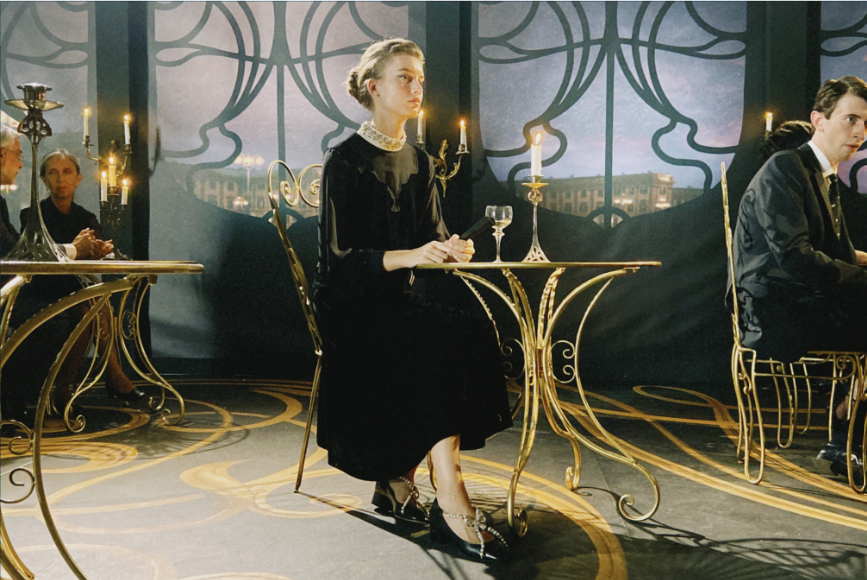
Every element of the theatre's interior (curtain sides, windows, floor, tables, chairs, candelabras) features Art Nouveau motifs recalling the works of French masters such as Hector Guimard, architect of the Paris Metro stations (1899-1903). This is Italy, however, so the style would more accurately be called Liberty; whose influence on glass at the time finds its undisputed maximum expression in the series of windows for the so-called Casina delle civette, designed by artists including Duilio Cambellotti, Paolo Paschetto, Umberto Botazzi, and Vittorio Grassi, guided by master glassmaker Cesare Picchiarini, for the small hunting lodge inside Villa Torlonia in Rome in around 1910.
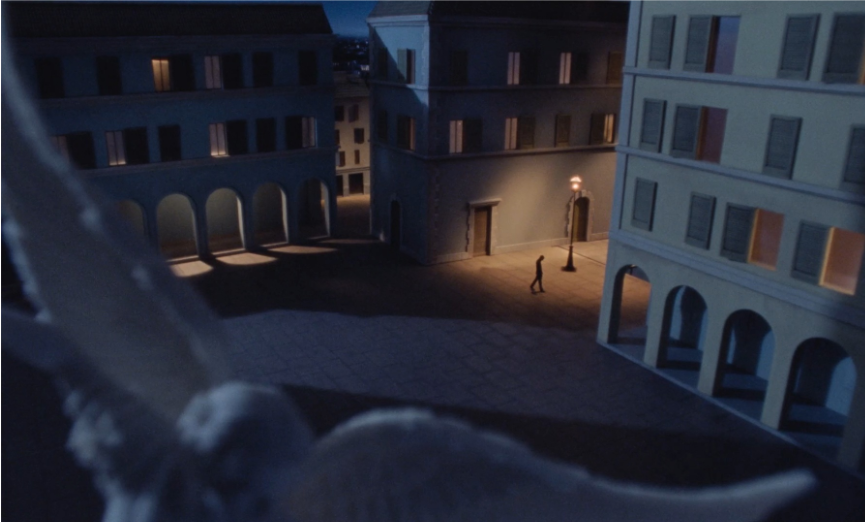
At the same time, the play of light in these scenes and, in particular, in the stop-motion cityscapes with their long shadows, harks back to the Expressionist cinema of Friedrich Wilhelm Murnau and Fritz Lang, and the use of ??models/dioramas, handcrafted by Villoresi, evokestheirextensive use in masterpieces such as Dr. Mabuse (1922) and Metropolis (1927). Once again, however, these images evoke Italian art, speakingthe metaphysical language of Giorgio de Chirico and his Piazze d'Italia (1934-1937), in the large porticoed spaces where the characters walk.
Classical culture remains in the background of the film’s story, so when Eura slips inside a mysterious house in Milano and disappears, Orpheus has no choice but to chase her into what turns out to be another dimension, accompanied by the Man in Green (Vinicio Marchioni) and welcomed by a strange landlady (Aomi Muyock). It is the moment of catabasis (from the Greek κατα- "down" and βαινω "to go"), the descent into the underworld; an episode experienced in ancient literature by Ulysses and Aeneas, in addition to Orpheus, and by Dante in modern literature.
While the myth of Orpheus, already known to the poet Ibycus of Reggio Calabria in the 6th century BC, is set in Thrace (a land of shamans who served as intermediaries between the worlds of the living and the dead, according to Herodotus), in Homer’s Odyssey (XI, 152-207; 800-600 BC), Ulysses descends into Hades, situated at the end of the ocean, on advice from the sorceress Circe to learn his future destiny. Hercules also descends to the underworld for the last of his twelve labors to defeat Cerberus, Pluto's faithful three-headed dog, guardian of Hades (Pisander of Rhodes, Heraclea, 600 BC).
The sixth book of Virgil’s Aeneid (1st century BC), sees Aeneas descending to the kingdom of Dite (the Greek Hades), aided by the Cumaean Sibyl, with a golden bough to be ferried across by Charon.
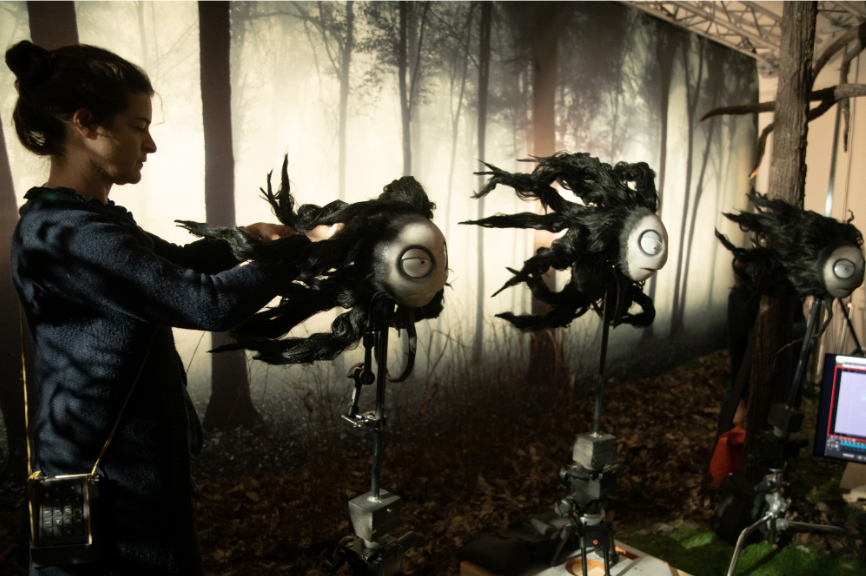
Several of these elements recur in the Divine Comedy (1300s), where Dante Alighieri, not coincidentally, chooses the poet Virgil to be his traveling companion in the first canticle, dedicated to his journey through Hell. They travel to many infernal places include the forest of suicides (Inferno XIII), encountering the harpies: bird-women creatures with clawed feet. On closer inspection, they can be spotted in a new guise, but still among the trees, in Villoresi's film,where they are the Melusine.
Dante also has other catabases in mind: above all, obviously, Christ's descent into Limbo, as narrated in the apocryphal Gospels, in which Jesus saves the just who lived before him, starting with Adam, and medieval "visions," including those narrated by the Venerable Bede, the 8th century English monk Drythelm, the Irish knight Tnugdalo (12th century), and Muhammad who, in the Quran, takes a journey to heaven where he sees the torments of hell and the beauties of paradise.
More recently, that middle ground between life and death, between reality and imagination, has provided congenial terrain for some of cinema’s greatest writers: the aforementioned Jean Cocteau, of course, and filmmakers like Federico Fellini, David Lynch, and Tim Burton, who have always loved to navigate the two worlds.