The Law according to Lidia Poët 3: injustice and patriarchy amidstlocations in Turin andworks of art
ART AND LOCATIONS: CINEMA IN DETAIL
The third and final season of The Law according to Lidia Poët, starring Matilda De Angelis, Jacopo Barberis, and Eduardo Scarpetta, about the first woman to be admitted to the Italian bar in 1919, returns to the city of Turin. While the skyline of the capital of the Piedmont region, often seen in establishing shots, features the usual iconic sites — the Mole Antonelliana, the dome of the Chapel of the Sacred Shroud, the Basilica of Superga in the distance — the new episodes showcase both locations like Palazzo Carignano,that have providedaconsistent backdrop to the story, and lesser-known places seen for the first time. This column, dedicated to art and locations, has already examined the architectural complexes such as Guarino Guarino's dome (1680) and Palazzo Carignano (1679-85), which were also dominant settings in theseries The Leopard.
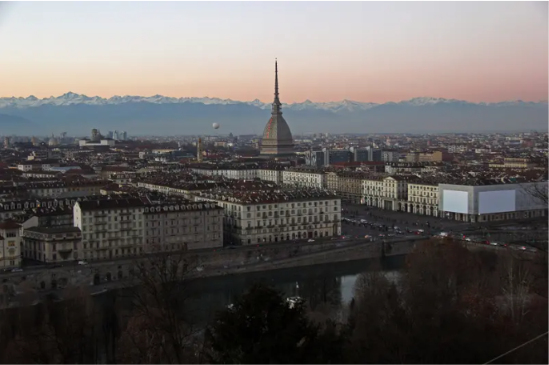
The Mole Antonelliana, however, is a different story. It was under construction and covered in scaffolding during Season 1; now it is complete. Work on the building, designed by Alessandro Antonelli, beganin 1863 and continued until its inauguration in 1889, the final years coinciding with Lidia Poët’s professional growth. Having graduated in 1881, she practiced in the shadow of her brother Enrico, waiting for her right to be recognized as a member of the bar association. That would come almost 40 years later when the Sacchi Law repealed the so-called "marital authorization".
Today considered the architectural symbol of Turin, the monument stands on land purchased by the Jewish community for the construction of a new temple after the Albertine Statute decreed freedom of worshipin 1848. Antonelli designed a 47-metre-tall eclectic-style building, but construction was slow, and differing visions led to the site on Via Montebello being exchanged for one on San Salvario where the new synagogue was later built. The City of Turin, meanwhile, commissioned Antonelli to complete the project, with the dome rising to its current 113 metres, which was later dedicated to King Victor Emmanuel II.
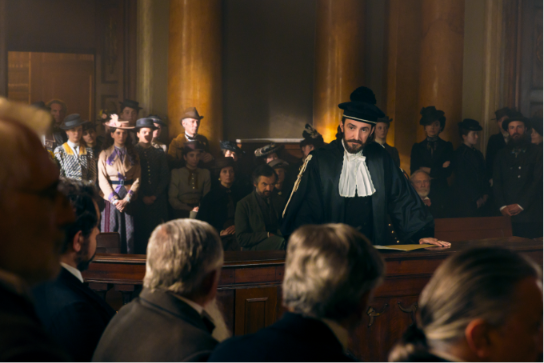
Another location that recurs across the 18 episodes of the three seasons is the Curia Maxima, setting for all the courtroom scenes. In the 17th century the building was used as a state prison based on a design by Carlo Castellamonte; under Victor Amadeus II of Savoy it became the seat of the state magistrates. It was partially completed between 1838 and 1839 by Ignazio Michelato designs by Filippo Juvarra and Benedetto Alfieri.
While the aforementioned buildings and complexes can all been seen in Episode 1 of Season 3, Episode 2 follows the Poëts’s investigations to an atelier andfocusses on the adventures of painters Luigi Cassel and Elio Storti (fictional characters who explore the theme of forgery, topical also in Stefano Ludovichi’s recent The Big Fake). Here they find an unfinished, blood-stained painting of The Battle of San Martino. The battle, on 24 June 1859, pitted the victorious Franco-Piedmontese navy led by Napoleon III and Vittorio Emanuele II against Emperor Franz Joseph of Austria and marked an important step towards the unification of Italy two years later. Given the battle’s significance, many pictorial versions were produced soon after, including a canvas by Vincenzo Giacomelli at the Museo del Risorgimento in Milan (1861), one of Napoleon at the Battle of Solferino by Jean-Louis-Ernest Meissonier (1863; Château de Compiègne), various moments in the battle painted by Pierre-Paul Comba and Tomaso Soatti (Genoa, Museo del Risorgimento), large frescoes by Amos Cassioli (1886) for the Hall of the Risorgimento of the Palazzo Pubblico in Siena and, of course, the central hall of the Tower of San Martino della Battaglia.
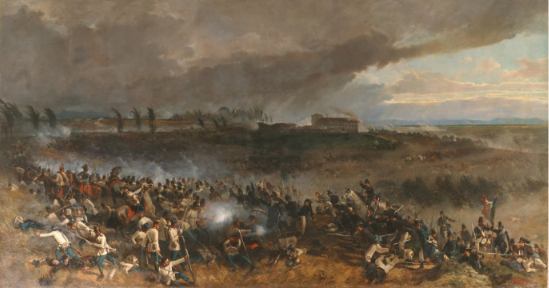
For obvious reasons, the version used in the series is the painting by soldier-painter Luigi Norfini (1874), housed in the Museo del Risorgimento in Turin (the characters note that the painting is for the city hall). The work was commissioned by Victor Emmanuel II himself and depicts the capture of the Cascina Contracania (Desenzano sul Garda, Brescia).
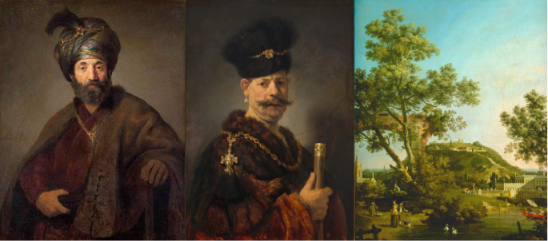
In addition to The Battle of San Martino,other paintings in Storti's studio include copies of works from the Metropolitan Museum of Art in New York and the National Gallery in Washington (who do not ask for reproduction rights for many of their works): from the former, The Amazon by Gustave Courbet (1856), from the latter Rembrandt’s Man with a Turban (albeit reversed) and The Polish Horseman (1635 and 1637) and, above all, a canvas that Lidia recognizes as a Canaletto, his Capriccio of an English Landscape with a Palace (c. 1754).
That episode, which sees Lidia and Jacopo strollbeneath the portico of the city hall, pointing out Vincenzo Vela's monument to Vittorio Emanuele II (1863-66), also provides a perfect cinematic itinerary. To reach the home of Storti’s widow, Lidia describes the route, first to the church of San Michele Arcangelo, then to the fountain of Crowned Italy in Piazza Cavour (the screenplay places it in a square named for Cesare Balbo) and the statue of General Guglielmo Pepe in Piazza Maria Teresa.
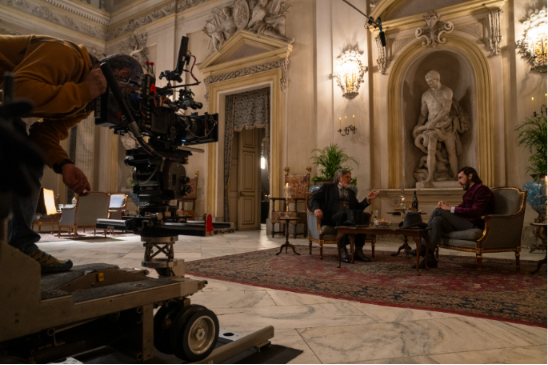
In the next episode, Enrico Pöet meets the former royal prosecutor in a sumptuous setting: a room in Racconigi Castle. The actors are seated in armchairs in front of a niche with the statue of Hercules and the Hydra by Giovanni Battista Borra (1757) flanked by two oriental vases.
The juvenile detention centre, setting for several sequences in Ep. 5, is the Colombara estate in Livorno Ferraris in the province of Vercelli. The site, already known as a travelers’ hostel by the end of the 13th century, was a farmhouse in the 15th century and over the hundred years that followed became a rice-growing estate, a sort of village with houses, shops, and a parish. It was still in existence in the 19th century, owned by the cadet branches of the House of Savoy, before passing in 1868 to the Magnani family of Biella, and then in 1935 to Cesare Rondolino.
The residential aspect of the estate’s former self-contained community is revived here, providing a settingin the story as the living and working spaces for many poor families. Entangled in issues of justice, they are defended by Lidia Pöet who dedicated her entire career, even before she was admitted to the bar, to the most defenceless: children, women, the poor, and the marginalized.
READ TOO: