The Devil Wears Prada 2: Brera Courtyard and Leonardo da Vinci's Last Supper
ART AND LOCATION: CINEMA IN DETAIL
Twenty years after the iconic The Devil Wears Prada, Andy Sachs and Miranda Priestly, played by Anne Hathaway and Meryl Streep, return to the screen, directed once again by David Frankel. This time, they are allies in a fight to save Runway magazine from bankruptcy amidst the print media crisis.
Towards the end of the film, Milan takes centre stage. In addition to 16th-century Villa Balbiano on Lake Como, rented by Benji Barnes (Justin Theroux) and Emily Charlton (Emily Blunt) who also receives a Monet and a Klimt from him, there are shots of the Royal Palace, Sforza Castle, and drone footage of the Piazza del Duomo (its Gothic-Renaissance church in full view) and the 19th-century Galleria Vittorio Emanuele II, where Meryl Streep later strolls alone at night.
A couple of locations, however, deserve further exploration. The first is the courtyard of the Brera Academy where an important fashion show is held. Models strut across the stage with their Mannerist steps, but the scene belongs to Lady Gaga (Shape of a Woman) who sings and dances in a cameo that has already gone viral.
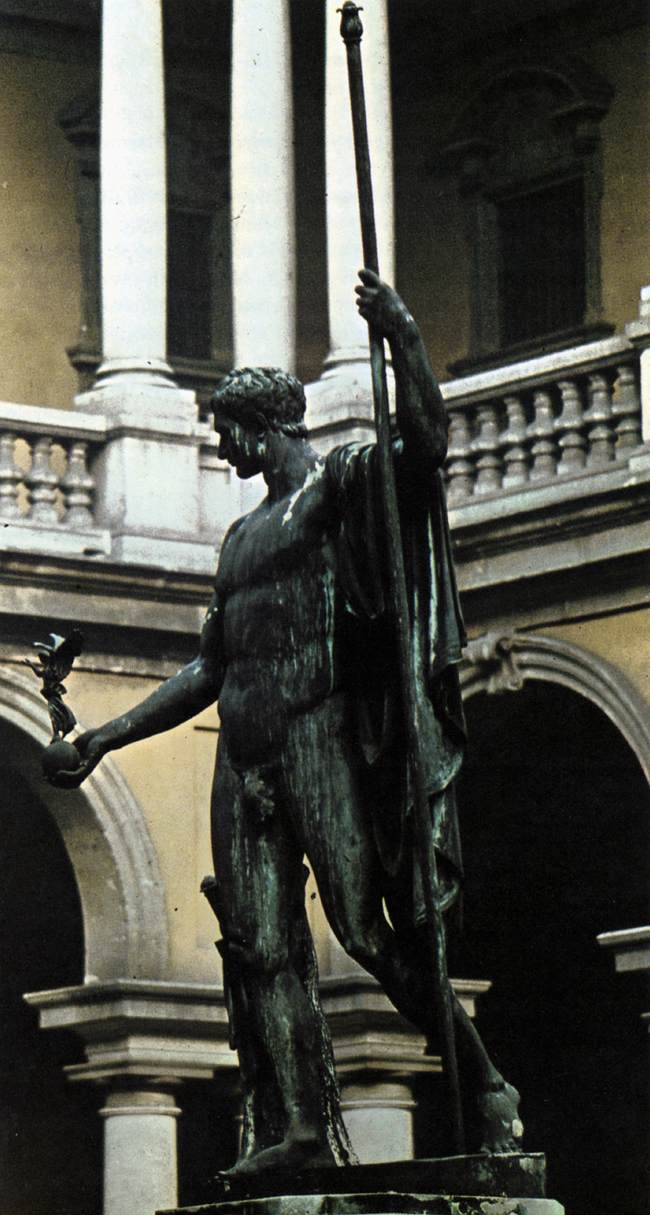
Standing in the centre of the courtyard, and catwalk, is the famous bronze statue of Napoleon as Mars (1810), commissioned from Antonio Canova in 1807 by Charles-Jean-Marie Alquier, France’s ambassador to Rome, at the request of Prince Eugene de Beauharnais, viceroy of the Kingdom of Italy and Napoleon's stepson. The bronze came from cannons from Castel Sant'Angelo; the plaster cast created as a model for the lost-wax casting is preserved in one of the rooms of the Pinacoteca di Brera.
The sequence in the film most likely to attract the attention of art history enthusiasts, however, is undoubtedly the scene inside the refectory of Santa Maria delle Grazie in Milan. The set used for this sequence was purpose-built to be a perfect replica of the space: it seems important to specify this given how common and, sadly unsurprising, the use of public spaces for private purposes has become, at every latitude. The sequence shows the entire room, which is part of the architectural works entrusted to Bramante by Ludovico il Moroto celebrate the Sforza family. The shorter sides are decorated with parts of the fresco of the Crucifixion by Donato Montorfano (1495), and – of course – with the mural painting of The Last Supper by Leonardo da Vinci (1495-1498).
Although the screenplay references "frescoes", it should be noted that the celebrated The Last Supper is not actually a fresco, but was dry-painted (a secco). Leonardo tried to approach the wall as he did wood, a base more suited to his slow and meticulous style of painting where he constantly modified the image, layering multiple strokes of paint to create effects of transparency and light, something that is impossible with frescoes which need to be completed before the plaster dries. Leonardo created a grease-heavy tempera by combining pigments with egg yolk and oil, but it didn't work as he had hoped. Still today, restorers are fighting to save the painting that had already begun to deteriorate inexorably just months after being completed.
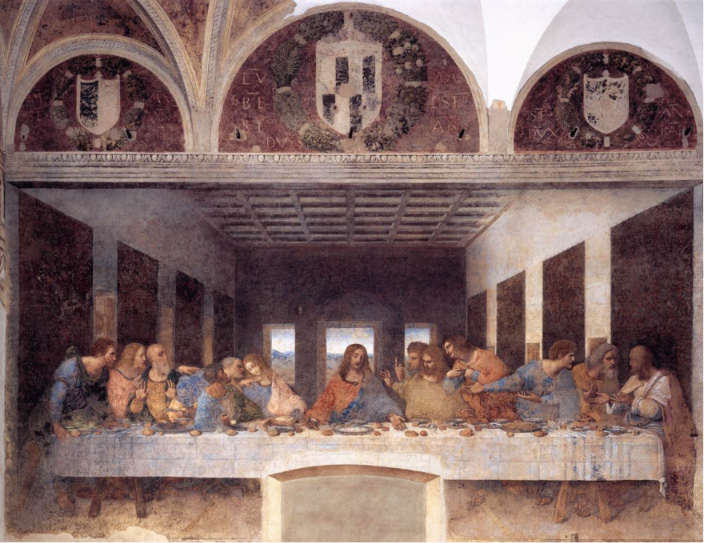
The details of the image, whose condition makes it only roughly legible today, are appreciated primarily thanks to later copies and re-touching. Set in a perspective that, deceiving the eye (an effect known as trompe l'oeil), enlarges the refectory, the scene depicts a room with a coffered ceiling with a classic da Vinci landscape visible through the windows.
In the foreground, a large table occupies the entire horizontal surface of the wall, laden with plates, bread, bottles, and glasses, the only cutlery being knives, a philological detail from Leonardo, as forks, a medieval invention, were non-existent in the time of Christ and the apostles. Divided into groups of three, the apostles are gathered around Jesus, immortalized at the exact moment when he is telling them that someone will betray him: their reactions,with each character’s expression fully realised, are the perfect example of the "doctrine of affections" which da Vinci considered essential to painting, giving a silent art its voice.
Another unusual feature of Leonardo's painting is his rendering of Judas. He is identifiable here not because, as in manyThe Last Suppers, he is sitting on the opposite side of the table, or dressed in yellow (the colour of envy, infidelity, and assigned to Jews by the Fourth Lateran Council in 1215), hasred hair (also traditionally negative)or is near a cat (the quintessential unfaithful animal). Da Vincichose other ways to distinguish the traitorous apostle. Some are more common; the bag of coins in his hands (with which he will sell Jesus);his left-handedness (the devil's hand); a particularly distinctive nose (in an anti-Semitic approach); while another is decidedly niche, namely the saltcellar knocked over on the tablecloth. The detail, seen clearly in copies (e.g., Giampietrino, c. 1520, formerly at the Certosa di Pavia, now in London’s Royal Academy), and evident close up in Santa Maria delle Grazie, is connected to a rhetorical image still in common use.
In addition to bringing bad luck to the superstitious, spilling salt is linked to expressions like "not having salt in your head". Salt was associated with intelligence and wisdom as well as having a well-known economic and symbolic value. Judas spilling the salt is therefore an encapsulation of all the reverse, negative deficits.
It is fitting to end this column with anothernoteabout Leonardo, one that is perfectly suited to The Devil Wears Prada. In the horror vacui of his career, the eclectic Florentine turned "designer" for the wedding of Ludovico il Moro and Beatrice d'Este in 1491; we know that he made an outfit for the humanist Antonio Grifo, a reader of Dante at the Sforza court at the time, as he probably did for others.
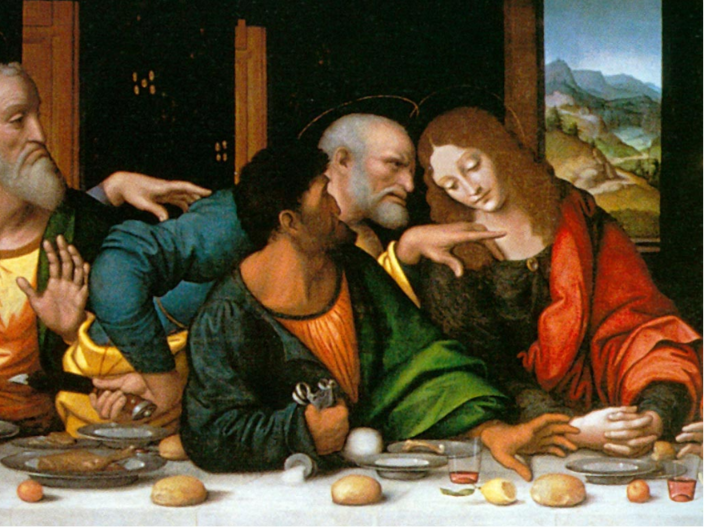
ca. 1520, London, Royal Academy) - © Web Gallery of Art