Pietro Marcello's 'Duse': portrait of an indomitable diva
Duse by Pietro Marcello is dedicated to Eleonora Duse (Vigevano 1858 – Pittsburgh 1924) in the centenary year of her death and was presented in competition at the 82nd Venice Film Festival. Nicknamed "La Divina” (The Divine One), she was the greatest stage actress of her time, the era between the 19th and 20th centuries, and also known for her connection with poet and writer Gabriele D'Annunzio, for whom she was a muse.
An Italian-French co-production, Duse is produced by Palomar, Avventurosa, Ad Vitam, Berta Film, Rai Cinema, and stars Valeria Bruni Tedeschi as "la Divina". The screenplay was written by Letizia Russo, Guido Silei, Pietro Marcello. The film will be released in theatres on 18 September by Piper Film.
Valeria Bruni Tedeschi as Eleonora Duse
"Theatre is not a museum. I need fire". The phrase, uttered by the protagonist, clearly highlights what the director wanted to convey about his Eleonora Duse: "I didn’t want to make a biopic but present the spirit of Eleonora Duse. Those were the years of dissolution. She is a nineteenth-century character looking towards the next century."
Pietro Marcello had no hesitation in choosing Valeria Bruni Tedeschi for the title role. Many things unite the actresses: "Duse wasn't a star; for her, work was oxygen - like it is for me," says Bruni Tedeschi, who drew inspiration for her character from William Weaver's biography and the letters she wrote to her daughter, Enrichetta (played by Noémie Merlant), with little other material about her available.
The cast includes Fanni Wrochna as Desirée, her Austrian assistant; Fausto Russo Alesi as D’Annunzio; and Edoardo Sorgente, Vincenzo Nemolato, Gaja Masciale, Vincenza Modica, Mimmo Borrelli, Savino Paparella, Noémie Lvovsky, Rita Bosello, Marcello Mazzarella, Vincenzo Pirrotta, Alessio Gorius, Federico Pacifici, Giovanni Morassutti, Nathan Macchioni, Dafne Broglia.
'Duse': trailer and plot
Eleonora Duse’s legendary career appears to be over; but, during the ferocious times spanning the Great War and the rise of Fascism, La Divina feels a call stronger than any sense of defeat and returns to where her life began - the stage.
She is driven not only by the desire to act, but also by a profound urgency: the need to reaffirm her presence in a world that is inexorably changing and threatens to take everything from her, even the independence earned with a lifetime of work. Unexpected financial setbacks force her to face a choice, and Eleonora again chooses the theatre as the only space of truth and resistance.
With her art as her only weapon, she defies time and disenchantment, transforming every word and gesture into a revolutionary act. But beauty pays a high price against the brutality of power and history, her relationships seem to dissolve, and her health deteriorates.
Eleonora undertakes one last journey, demonstrating that one can renounce life, but never one's own nature.
Venice, the location of 'Duse'
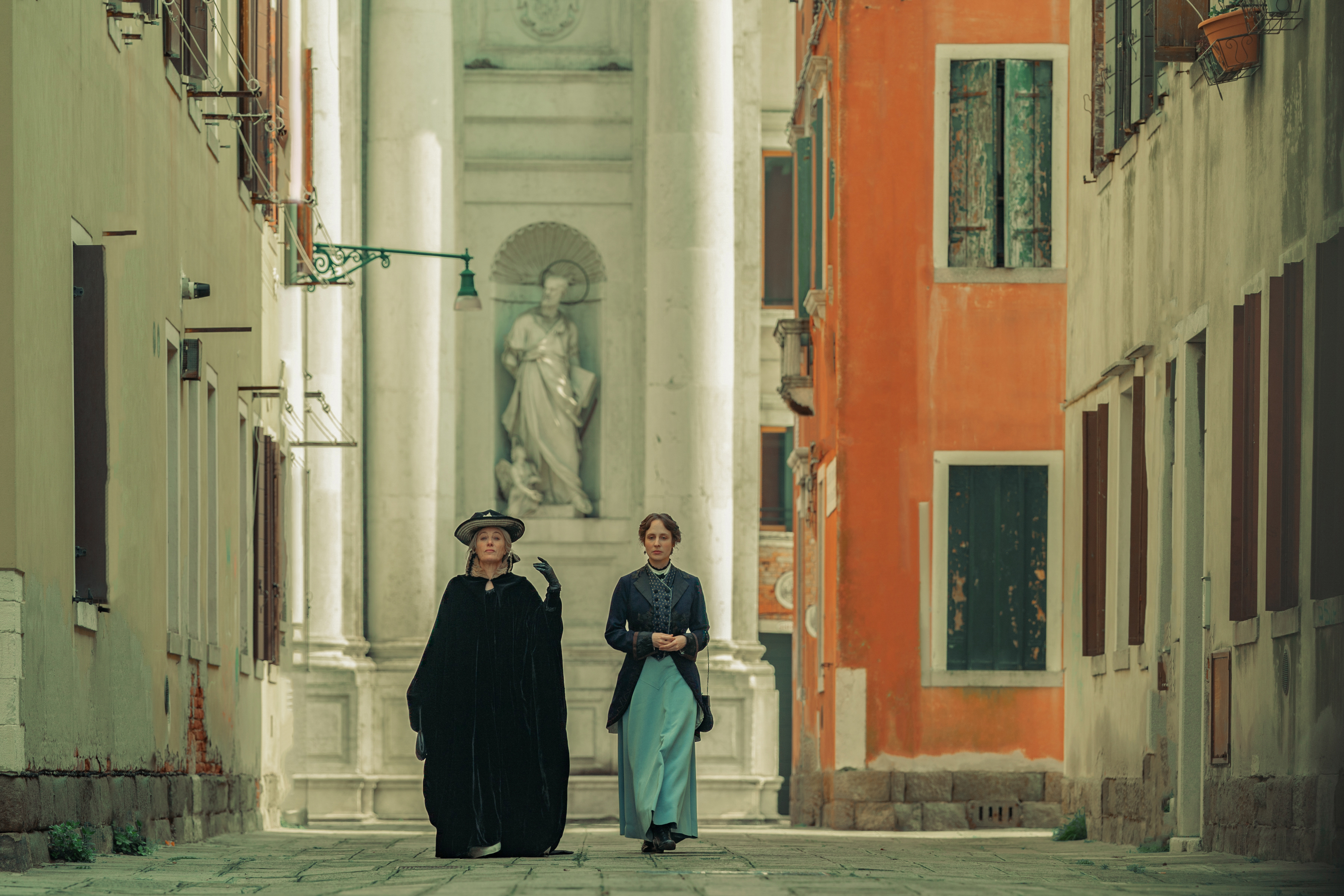
Duse is inextricably linked to Venice. "One of the most beautiful cities in the world," the director confesses. "I had the privilege of filming in Venice and of bringing this film back to the lagoon. It's something that moves me deeply".
Filming began on March 4, 2024 in Venice, with locations including: Campo San Fantin, La Fenice Theatre, Goldoni Theatre, Campo San Beneto, Palazzo Fortuny, Campo and Fondamenta Santa Giustina, Fondaco Bridge, the Jesuit area, Palazzo Donà delle Rose, and Palazzo Polignac in Dorsoscuro.
Part of the film is set in Rome, with locations that included: private homes, the former Carlo Forlanini Hospital, Palazzo dell'Aeronautica, Palazzo Orsini Taverna, and Borgo Mandela. Locations in Lazio included: Frascati, Villa Aldobrandini; Tivoli, piazza del Comune and piazza del Governo; Cerveteri, the Sasso area; Viterbo, the medieval district of San Pellegrino and the area between the Teatro dell'Unione and square.