Five villas in one: Sicilian Baroque and more in "The Art of Joy"
OCCHIO AI DETTAGLI - Movies between art and location
Baroque is the dominating style in Valeria Golino's The Art of Joy: expressed not only as large aristocratic estates, but also as urban excellence. It features Catania, whose historic centre was inscribed as a UNESCO World Heritage in 2002, and a further seven late-Baroque centres in the Noto Valley (Caltagirone, Militello, Modica, Noto, Palazzolo Acreide, Ragusa, Scicli). Sicily and Lazio also provided other locations.
The Sicilian villa where young Modesta (Tecla Insolia) finds herself living as a guest of Princess Gaia Brandiforti (Valeria Bruni Tedeschi), after the stormy events of her childhood, is immediately striking. Scenes set at the 18th century villa were actually shot in four different villas in Bagheria: Villa Valguarnera, used by Ferzan Ozpetek in La dea fortuna (2019); Villa Trabia; Villa Spedalotto and Villa Palagonia, plus Villa Parisi in Monte Porzio Catone outside Rome.
Villa Valguarnera was designed by the Dominican architect Tommaso Maria Napoli in 1712 for the Princes of Valguarnera, still today the hereditary owners. It has two imposing symmetrical wings which reflect the influence of Bernini (evoking the colonnade of St. Peter's) and enclose a large courtyard in front of the main building. This consists of a recessed central building flanked by side wings, following an architectural model widespread since the Roman Renaissance, with examples that include Villa Farnesina, Villa Medici, and, early in the 1600s, the casino of Villa Borghese.
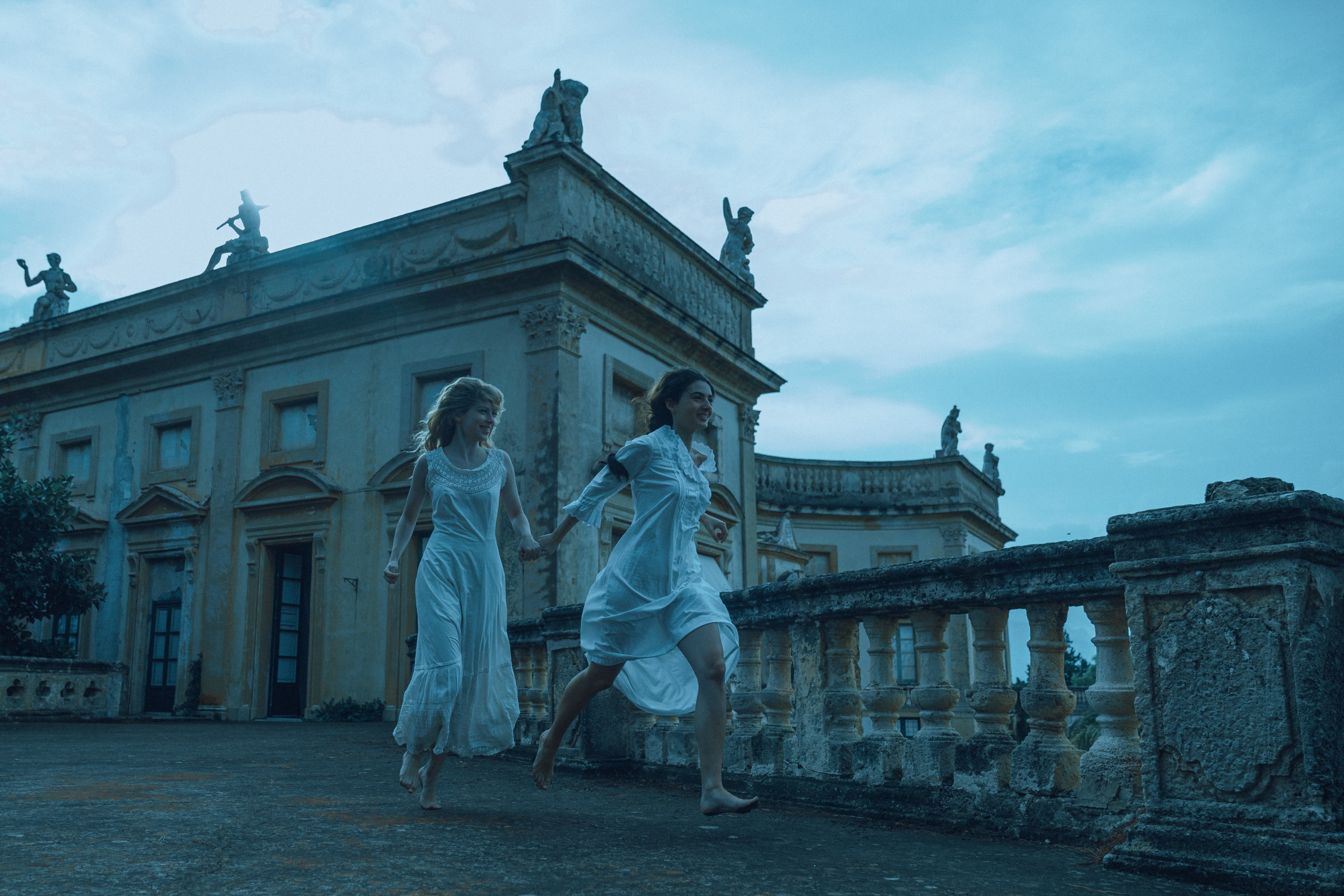
Modesta and Beatrice on the roof of a wing of Villa Valguarnera - © P. Ciriello
Princess Gaia (Valeria Bruni Tedeschi) appears several times on the central terrace in the series, while Modesta and Beatrice run along the roof of the side wings in one of the most liberating sequences in the story.
Tommaso Maria Napolialso designed Villa Palagonia in 1715 for Ferdinando Gravina and Crujllas, Prince of Palagonia; while Villa Trabia was commissioned in the mid-1700s by the Prince of Comitini, Michele Gravina, from the architect-abbot Nicolò Parma. Villa Spedalotto (which served as Johnny Stecchino’s hideout in Roberto Benigni’s film of the same name (1991)) is just outside Bagheria, in the municipality of Santa Flavia; it was designed in neoclassical style, between 1783 and 1794 by architect Giovanni Emanuele Incardona, for the knight Barbaro Arezzo who later sold it to Marquis Paternò di Spedalotto who gave it the name.
Villa Parisi in Monte Porzio Catone provided the large central hall where Beatrice attends dance lessons with a dapper tutor, interrupted by the exuberance of Modesta. The villa, which is located very close to Rome, was built by Girolamo Rainaldi in the early 17th century as a summer residence for Cardinal Ferdinando Taverna. By 1614 it had passed to the rapacious accumulator of art and property Cardinal Scipione Borghese, nephew of Pope Paul V (1605-21), who commissioned several modifications from the architect favoured by the Borghese dynasty, Jan van Santen, a Dutchman better known as Giovanni Vasanzio, who built the Nymphaeum and the Secret Garden.
The decoration of the rooms was entrusted to a range of painters, including Giuseppe and Domenico Valeriani of Rome, the Bavarian landscape artist Ignazio Heldman, the Polish Taddeo Kuntze and Giovan Battista Marchetti of Lombardy.
The hall in The Art of Joy is the “party hall” which was frescoed in the 18th century, making it a perfect set for part of the villa in the story. The scenes offer glimpses of the Valeriani brothers’ frescoes which feature the female personifications of the Arts, four Telamons supporting architecture, and symbols of Rome, such as the she-wolf with Romulus and Remus above the fireplace, and busts of the emperors.
Damaged during WWII in Allied bombings, occupied by first Nazi, and later American, soldiers, Villa Parisi hosted families of displaced people until 1951.
From Orsini Odescalchi Castle in Bracciano to the urban layout of Catania
Another important location in Lazio is Orsini Odescalchi Castle in Bracciano, setting for the convent governed by Abbess Leonora, where the child Modesta is given refuge. The chapel and courtyard with fountain are actually in the Benedictine Abbey of Santa Maria del Bosco in Contessa Entellina (province of Palermo), today a hotel.
The peasant village around Villa Brandiforti, where Modesta rediscovers empathy for the simple people to whom she is naturally drawn, was created in the Valle Fame farm in Palazzolo Acreide (province of Syracuse). More historical - artistic excellence is represented by the few minutes set in Catania.
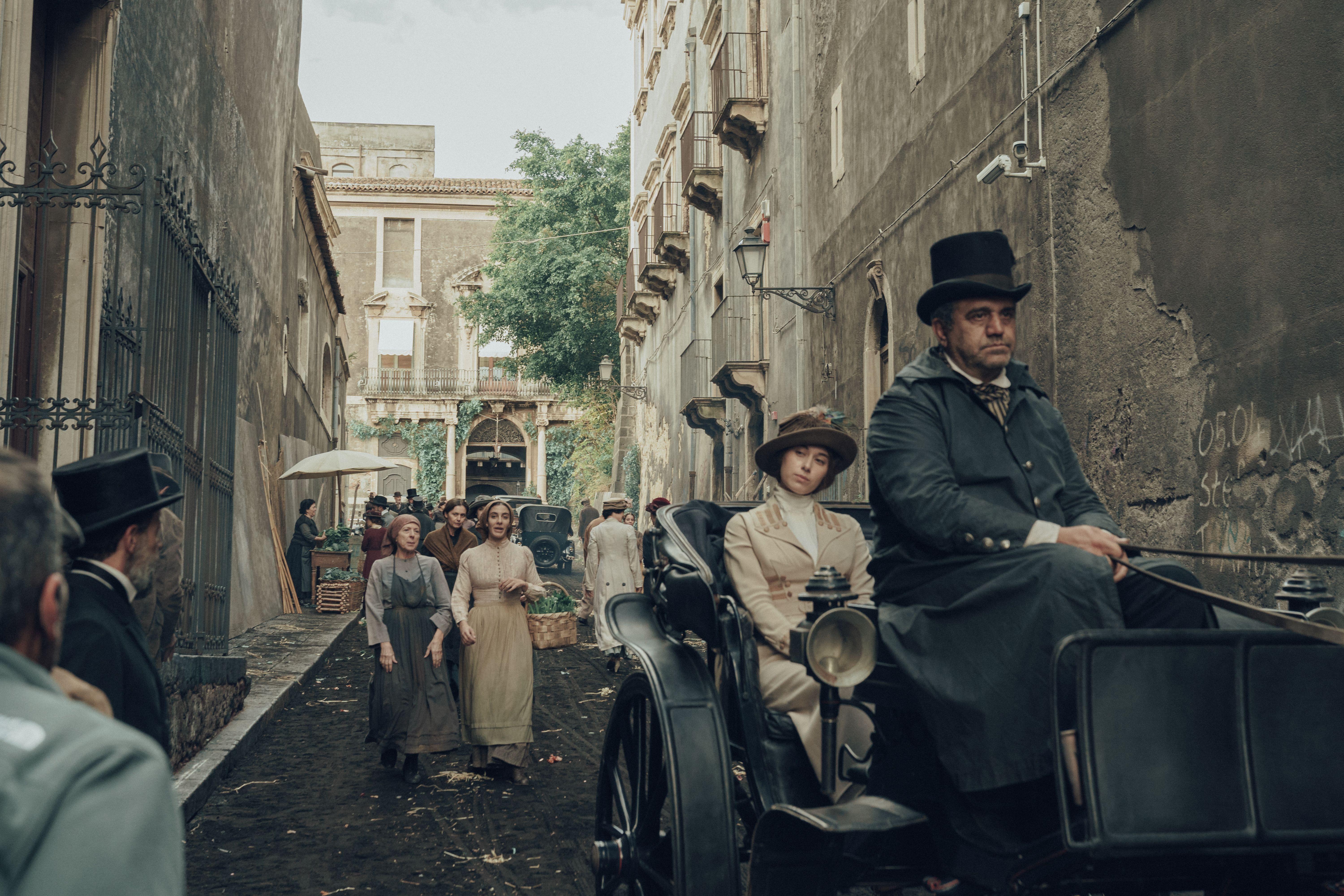
Via di San Benedetto in Catania: in the background, Palazzo Asmundo Francica Nava, the churches of S. Benedetto and S. Francesco Borgia - © P. Ciriello
The scenes show the city’s iconic Baroque centre, in particular Palazzo Biscarialla Marina and the Church of St. Benedetto. Modesta and others drive in a carriage to the former, while at the latter, she is fascinated by the eighteenth-century frescoes and the organ. A carriage, leaving Palazzo Asmundo Francica Nava, travels along Via di San Benedetto, flanked by the Churches of St. Benedetto and of San Francesco Borgia, both overlooking via dei Crociferi.
Palazzo Biscari in the historic centre was commissioned at the end of the 17th-century by Ignazio Paternò Castello, Prince of Biscari, and continued by his son Vincenzo. It provided the location for Coldplay’s music video Violet Hill (2008). Abutting the 16th-century walls of Catania commissioned by Emperor Charles V, it was built by architect Alonzo Di Benedetto after the terrible earthquake of 1693, and enriched with large windows sculpted by Antonino Amato of Messina. Later heirs continued to modify and expand the palace employing, among others, the architects Girolamo Palazzotto and Francesco Battaglia and the painter Giovanni Battista Piparo who frescoed some of the rooms, and was finally inaugurated in 1763. Two decades later, Goethe would be a guest there,in May 1787, while travelling through Italy on his Grand Tour.
The frescoes of San Benedetto in Catania
The church of San Benedetto was designed by Alonzo Di Benedetto at the beginning of the 18th century, and frescoed by Giovanni Tuccari some three decades later (1726-29). As Valeria Golino's use of her POV shows, Modesta is particularly enthralled by the Martyrdom of Saint Agatha, immortalizing her bond with Catania’s patron saint, whose story she has heard since she was a child from Leonora.
In the late 18th century, Antonio Battaglia covered the mural paintings by the artist from Messina with strips and pilasters at the behest of the clergy of Catania. Damage from WWII bombing prompted restoration work in 1947 which led to the rediscovery of Tuccari's frescoes and other gems.
Lunettes at the base of the vault feature a cycle of the Seven Virtues, theological and cardinal, alternating with the stories of St. Benedict. The saint is also triumphantly celebrated in the centre of the ceiling in a true Baroque tradition - from Pietro da Cortona to Palazzo Barberini - whose earliest and most emblematic context is the church vaults of Rome. The Coronation of the Virgin in the presbytery above the high altar is also by Tuccari.
The frescoes in the arches of the single nave are by other painters, some still unidentified, as in the case of the Martyrdom of Saint Agatha, in the centre of the left wall.