Rossellini’s Journey to Italy: A modern Grand Tour of cultural sites with the impromptu guides of the past
ART AND LOCATIONS: CINEMA IN THE DETAILS
The 4K restoration of Roberto Rossellini’s masterpiece, Viaggio in Italia (Journey to Italy), by Cinecittà, screened on September 5 at the 83rd Venice International Film Festival to mark 120 years since the birth of the Rome-born director, provides an opportunity for Art and Locatiosn to examine the Naples that Katherine Joyce (Ingrid Bergman) sees with her husband Alex.
The film’s title recalls the tradition of the Grand Tour and the extensive literature surrounding it including Goethe’s Italian Journey, the account of his travels between 1786 and 1788, published in two volumes in 1816 and 1817 respectively.
Rossellini’s film, however, does not present (at least not initially), as a journey of cultural education as the Grand Tour once was for northern European travellers, nor is it an itinerary through Italy’s principal cities. Instead, the setting is confined to Naples and the surrounding area. The reason for the journey undertaken by the English couple at the heart of the film is purely practical: they have come to take possession of the house left to them by an uncle in the open countryside at the foot of Mount Vesuvius. They arrive in Naples by car —Katherine is driving, the first of the many contrasts with the reality around her — and stay at the Hotel Excelsior on Via Partenope.
Their arrival on the seafront allows the camera to frame the Fontana del Gigante, a monumental 17th-century fountain with three arches, coats of arms, sea creatures, river deities and caryatids built between the late 16th - early 17th century for Antonio Alvarez de Toledo by the Florentine sculptors Pietro Bernini (who returned to Rome in 1606) and Michelangelo Naccherino (who completed it in 1633). The name of the fountain is associated with a context that has long since disappeared: it was originally built for the square in front of the Royal Palace, today’s Piazza del Plebiscito, to be placed near the colossal statue of Jupiter, a pastiche assembled in 1670 from a bust discovered at Cumae, known as “the Giant” (Il Gigante). Both works were removed in 1807 and 1815. The fountain, moved first to the Immacolatella building and then to Villa del Popolo, was installed at its present location in 1906.
The uncle’s house features 19th-century Neapolitan paintings. Characters talk beside a wall hung with canvases by Filippo Palizzi, an early proponent of Realism in 19th-century Neapolitan painting. With the exception of these interiors and a clutch of landscape / urban scenes (notably the funeral in Piazza Sanità and the final procession scene in Piazza D’Amato in Maiori (Salerno)) Journey to Italy mostly takes Katherine to places that are key to Naples’ cultural and tourist identity: the National Archaeological Museum (MANN), the Sibyl’s Cave at Cumae in the Campi Flegrei, the Fontanelle Cemetery, and the archaeological site of Pompeii.
Naples, MANN — © Web Gallery of Art
The National Archaeological Museum
At the first of these locations, Katherine is approached by a ‘guide’— an elderly man who, with no official license nor credentials, offers tourists snippets of information in return for a tip. He asks whether she would like to visit “the picture gallery” afterward, evidently referring to the Capodimonte Museum.
In the museum entrance, the camera frames a lion and other marble sculptures, then the two actors walk past the bronze Resting Hermes from the Villa of the Papyri at Herculaneum, whose masterpieces, discovered between 1754 and 1756, are shown in the next few seconds. The man first points out the Dancers of Herculaneum, 1st century BC Roman copies of Greek originals, adding a personal observation that the fourth resembles his daughter Marianna. Today, however, the identification of these figures as “dancers”, name given to them by Winckelmann, is no longer considered certain. They are more likely to be water carriers (hydrophorai) or Danaids, the daughters of King Danaus of Libya who, according to myth, were condemned by Zeus to endlessly pour water into a jar with a hole in its bottom.
He shows Katherine more bronze sculptures from the Villa of the Papyri, including the Sleeping Satyr — although he says it comes from a villa in Pompeii. Given the small horns on its head, the figure is more correctly identified today as Pan. He also shows her the Drunken Faun. The camera, meanwhile, focuses on Katherine’s point of view and lingers on one of the two extraordinary Runners, Roman copies of Greek models from the school of Lysippos (4th–3rd century BC) which, like the female statues mentioned before, are particularly striking for their extraordinarily expressive eyes, made from bone, ivory and grey and black stones.
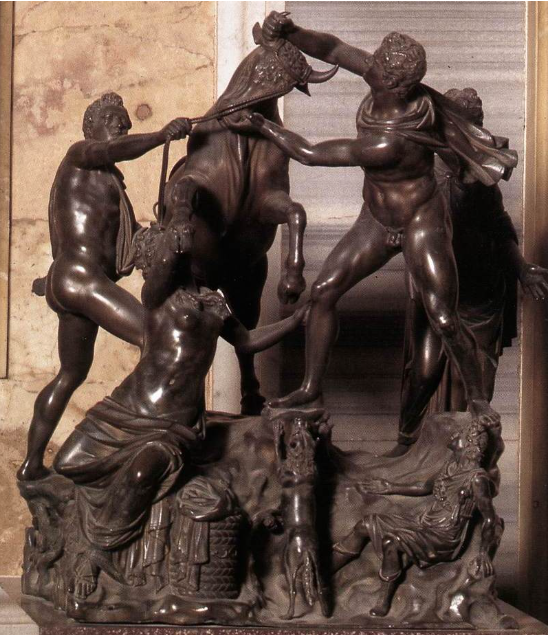
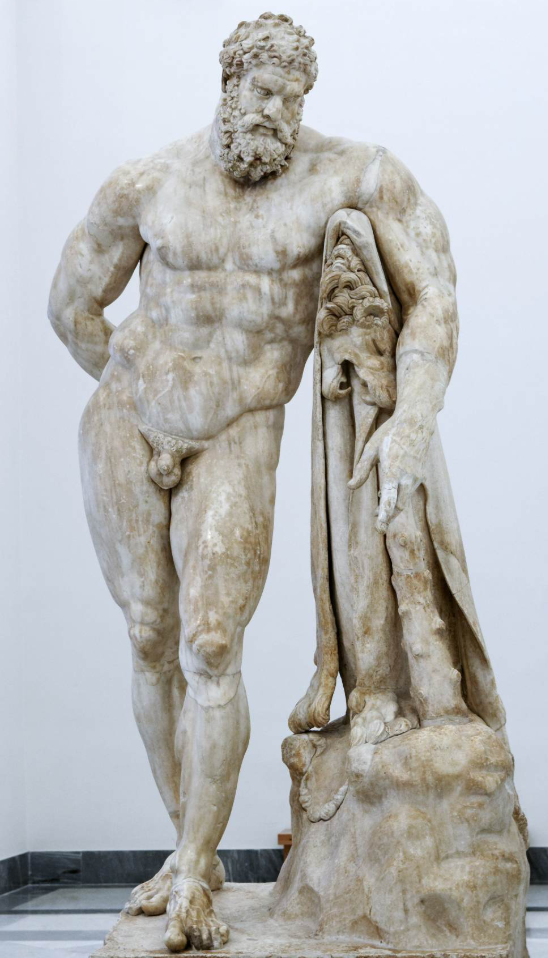
The visit continues past marble busts of Roman emperors — Caracalla, Nero and Tiberius, who the guide firmly describes as madmen - and a fragmented Venus with no arms or head. The final museum sequence, which began with the Farnese Lion, then located between the entrance gates and now displayed at the entrance to the grand staircase, concludes with two of the most famous marbles in the Farnese collection which arrived in Naples between 1734 and 1784 from Charles III of Bourbon, following the marriage of Elisabetta Farnese and Philip V of Bourbon in 1714: the Farnese Hercules and, facing it, the Farnese Bull. Both were discovered at the Baths of Caracalla in 1546 and kept for more than two centuries in the Farnese Palace in Rome. The Farnese Hercules depicts the resting hero with his identifying attributes: a club in one hand and a lion’s pelt draped over a shoulder. The Farnese Bull depicts the punishment of Dirce, stepmother of Amphion and Zethus, sons of Antiope, as they avenge the wrongs inflicted upon their mother. The impromptu guide leaves the scene with one final piece of misinformation: he attributes the first restoration of the Farnese Bull to Michelangelo. However, Michelangelo only suggested to Pope Paul III that the sculpture be used in a fountain to be built inside the Farnese Palace.
The Sibyl’s Cave at Cumae
Katherine travels to the Campi Flegrei, where she is particularly impressed by the Sibyl’s Cave at Cumae, discovered by archaeologist Amedeo Maiuri in 1932 near the ruins of the Sanctuary of Apollo that once towered over the acropolis. The Cave, a 101-metre-long trapezoidal tunnel carved into the tuff rock, has been dated differently by different scholars, with estimates ranging from the 10th to the 4th century BC. It is mentioned by Virgil in the Aeneid as the place where the famous Sibyl, priestess of Apollo, prophesies to Aeneas his future glory and the founding of Rome.
Here, another impromptu guide tells Katherine the story of Aeneas as if it were historical fact, placing it on the same level as the arrival of British troops during WWII who in 1943 strategically exploited the elevated position of the acropolis of ancient Cumae.
Pompeii and the Fontanelle Cemetery
After climbing Mount Vesuvius, where another unlikely guide shows Katherine small smoking craters, ash and lapilli which she photographs with her Rolleiflex, she goes with the Neapolitan wife of their host to the Fontanelle Cemetery at the foot of Mount Lotrecco, a profoundly affecting experience. Katherine is deeply moved at the sight of the 366 pits where the many people who died during the devastating cholera epidemic in Naples between 1836 and 1837were buried.
Still today, the atmosphere here is striking in this place, transformed by Luigi Santacroce, and later Leonardo Laghezza, into a genuine sanctuary of Purgatory where, for almost two centuries, Neapolitans have entrusted the souls of their dead to divine mercy with the traditional phrase: “Refrisco all'anema d''o priatorio.”
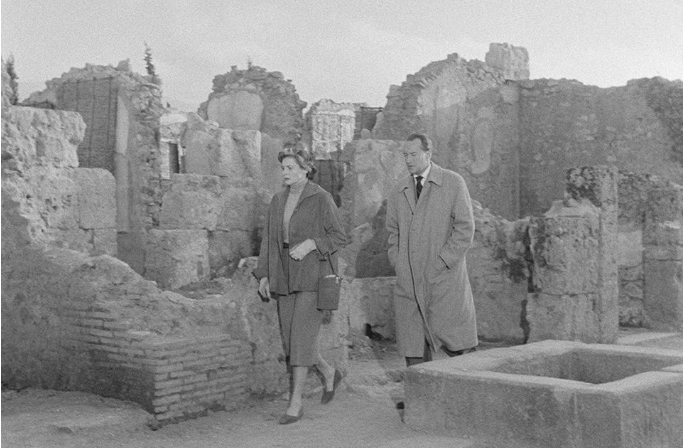
The final cultural and tourist destination is the archaeological site of Pompeii, where Katherine and Alex, invited by their host, have the opportunity to witness an extraordinary moment in a newly excavated area. They watch as plaster casts are made from the voids left by the bodies of victims of the eruption of October 24, AD 79. Shaken by the idea of those bodies that have been dead for centuries, Katherine wants to leave so they head out of the archaeological site, walking through ruins and past ancient villas. They cross the Via dell’Abbondanza, the decumanus maximus that ran from east to west across the city, and the famous Quadriportico dei Teatri, later used as the Gladiators’ Barracks. Yet the image that remains in their minds is of the two people who died embracing, a husband and wife: a symbolic detail that prompts them to reflect deeply and ultimately affects their later choices.