Founded in Etruscan times, ancient Saenae became a Roman city. Legend holds that Remus’ two sons, Ascanius and Senius, founded the city having fled Rome to escape their uncle Romulus, bringing with them the statue of the she-wolf and the twins, which later became the symbol of Siena. Historical reality, however, tells us that Saenae Iulia was a Roman colony from the time of Augustus.
Siena became a diocesan seat in the Early Middle Ages, when it was often in conflict with Arezzo over border issues, eventually resolved by the Lombard King Liutprand in Arezzo's favour. After the Carolingian period, the city was governed by counts, and from the 12th century, its growing commercial importance put it in competition with Florence and brought it closer to the Papal States, often reliant on loans from Sienese bankers. Later, Siena sided with the Ghibelline faction, in opposition to Guelph Florence, which it managed to defeat in the famous Battle of Montaperti (1260). The subsequent Guelph Government of the Nine made the Republic of Siena an early democracy, halted first by the plague of 1348 and then by the siege of Habsburg Emperor Charles V (1555), who ceded it to the Medici. Siena passed from the Medicis to the Habsburg-Lorraine dynasty (1737- 1799) and, following the Napoleonic era, became the first Tuscan city to be annexed to the Kingdom of Italy in 1859.
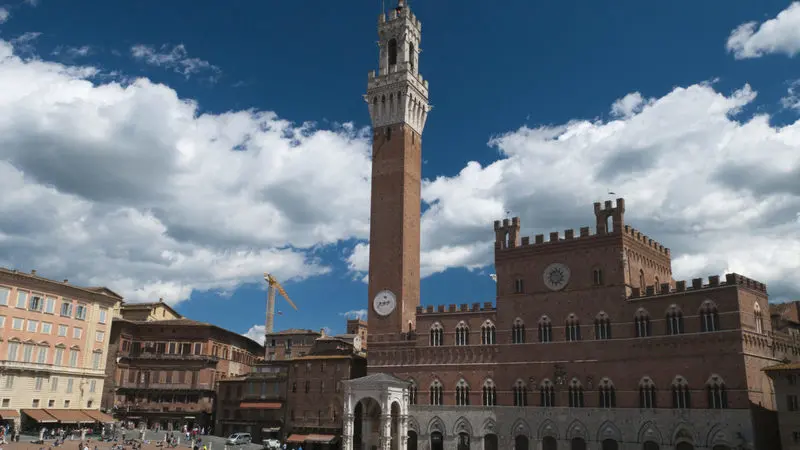
Still largely medieval in appearance, its historic centre is absolutely fascinating. The city extends radially around the dominant piazza del Campo, the setting for palazzo Pubblico, with its looming Torre del Mangia—named for an ancient bell-ringer, several noble palaces, and fonte Gaia, decorated by Jacopo della Quercia in the early 15th century.
The palace, housing the Civic Museum, preserves rooms and frescoes of great prestige, including those by Simone Martini (Maestà, Guidoriccio da Fogliano) and Ambrogio Lorenzetti (Allegory of Good and Bad Government).
Fonte Gaia is the most famous example of the "bottini" system which brought water to Siena from the surrounding hills (the city has no river) with a system of underground canals (approx. 25 km).
The other key medieval hub is the area around the cathedral which includes: the Romanesque cathedral dedicated to the Assumption in its characteristic black and white, the baptistery of San Giovanni, the old baptistery (now known as the crypt), the remains of the intended expansion of the cathedral which was interrupted by the plague of 1348, and the Museo dell'Opera del Duomo. This complex houses masterpieces from art history: the floor, pulpit by Giovanni Pisano, stained glass window and the Maestà by Duccio da Buoninsegna, Romanesque frescoes, and the baptismal font, which Lorenzo Ghiberti, Donatello, and Jacopo della Quercia worked on.
Toscana Film Commission
Via San Gallo 25 — 50129 Firenze
Phone: +39 055 2719035
Fax: +39 055 2719027
Email: staff@toscanafilmcommission.it