Located in the heart of Emilia-Romagna and the Po Valley, Modena is one of the main centres of the ancient region of Emilia, owing its name to the Rimini-Piacenza road that connected with the 8th Augustan region, Regio Aemilia, in the 2nd century BC.
In the Early Middle Ages, Modena marked the border between the territories of Langobardia Maior and the Exarchate of Ravenna, by the Late Middle Ages it was considered a part of Lombardy, and under Frederick II (13th century) was included in the so-called "Pavia inferius".
The following centuries are linked to the Este family: Borso d'Este received the duchy in 1452, from the Habsburg Emperor Frederick III, which was expanded in 1471 to include Ferrara, thanks to Pope Paul II (1464-1471). After the devolution of Ferrara in 1598, Cesare d'Este moved the capital to Modena, which, more or less, maintained its autonomy until the unification of Italy.
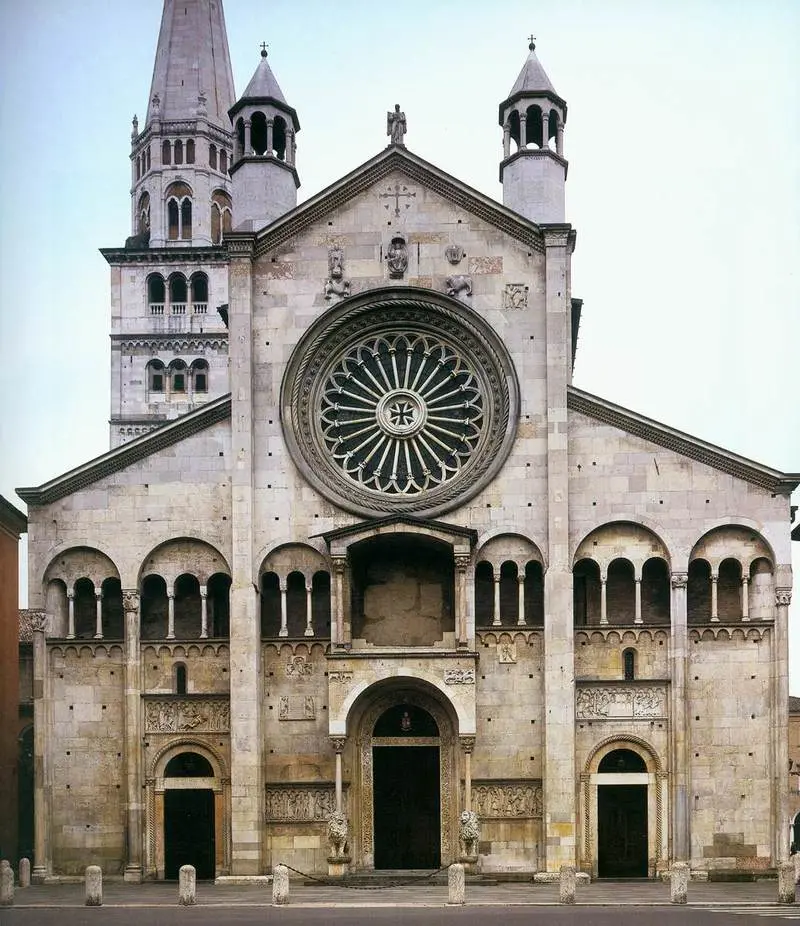
The city develops around the piazza del Duomo, dominated by the Romanesque Cathedral of San Geminiano, designed by Lanfranco in 1099 which features massive masonry, façade slabs with the Stories of Genesis sculpted in the following decade by Wiligelmo, the porta della Pescheria with an Arthurian Cycle and the Cycle of the Months, and a bell tower, the Ghirlandina, whose construction began in 1179 and lasted for the next two centuries.
Other noteworthy highlights include: the Estense library in Palazzo dei Musei; Palazzo Ducale, now home to the Military Academy, previously the Este residence (17th - 19th centuries); the Franciscan Church of San Barnaba; and the monumental cemetery of San Cataldo.
Emilia-Romagna Film Commission
Viale Aldo Moro 38 — 40127 Bologna
Phone: +39 051 5278753
Email: filmcom@regione.emilia-romagna.it