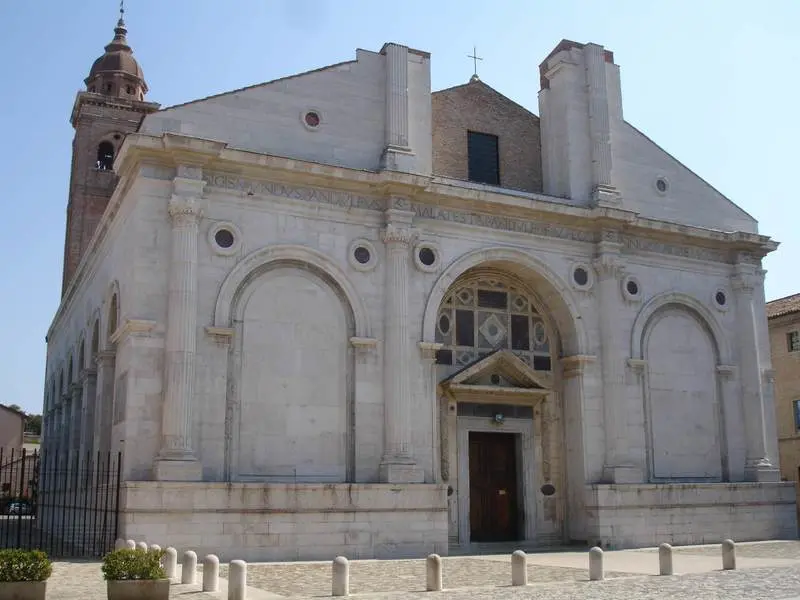
Founded as a Roman city in the 3rd century BC, Rimini was an important waypoint between the north and south of the peninsula. In the Byzantine era, it formed the maritime Pentapolis with Pesaro, Fano, Senigallia, and Ancona. Between the Middle Ages and the Renaissance, it was a fiefdom, a free commune, and later a lordship of the Malatesta family.
With the fall of the Malatesta in the early 16th century, Rimini came under the control of the Papal States, until Napoleon's entry in February 1797. It was annexed, in 1860, to the Kingdom of Sardinia and then became part of the Kingdom of Italy.
The city's nerve centre today is piazza Cavour: the site that was the Forum in Roman times and piazza del Comune in the Middle Ages. Here stands the Romanesque-Gothic Palazzo dell'Arengo and the 14th-century Palazzo del Podestà.
Of the Roman city, however, only the Arch of Augustus and the Bridge of Tiberius, which served as models for the Renaissance, remain.
Sites from the Malatesta era include Castel Sismondo and the celebrated Tempio Malatestiano (1447-1450), a sort of classical "container" that incorporates the 13th-century Franciscan church, built by Leon Battista Alberti and decorated by Piero della Francesca. Famous for its coast and seaside establishments, Rimini saw the inauguration of the first "Estabilimento privilegiato dei Bagni Marittimi" (Privileged Sea Bathing Establishment) in 1843, modelled on other European cities. Today, the bathing area, north and south of the Darsena and Molo, is 16 kilometres long and is one of the most popular in Italy.
In the world of cinema, Rimini is famously linked to Federico Fellini, who was not only born here but also celebrated his city "from a distance", in films shot on soundstages and other locations in Rome, such as I vitelloni (1953) and Amarcord (1973).
Emilia-Romagna Film Commission
Viale Aldo Moro 38 — 40127 Bologna
Phone: +39 051 5278753
Email: filmcom@regione.emilia-romagna.it