Some 50 kilometres north of Bologna, on the route to Venice, Ferrara is one of the most important cities in Emilia. Founded during the Barbarian invasions, it passed from the Byzantines to the Lombards (mid-8th century) in the Early Middle Ages, then to the Franks and then became part of the Holy Roman Empire. Allied with the Guelph faction in the 12th century, it saw the rise of the Este family from the 13th century, beginning with Azzo VI d'Este.
Ferrara had become so important by 1438 – the city had a university since 1391 - that it was chosen as the seat of the Council of Basel-Ferrara-Florence (1431-1445).
Ferrara became part of the Duchy of Este in 1559, along with Modena and Reggio. The devolution of Ferrara lead to its inclusion in 1598 in the Papal States, which sparked its decline between the 17th - 18th centuries. The city was then caught up in events of Napoleon and the Kingdom of Italy.
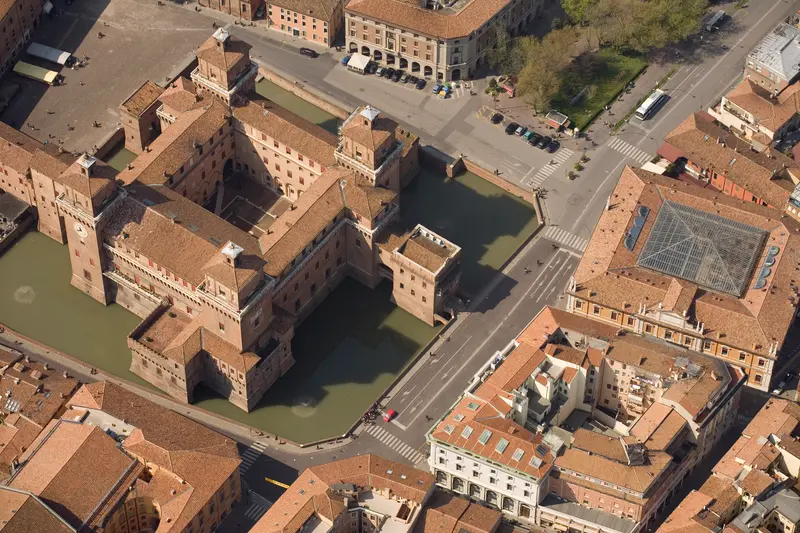
The modern-day perception of Ferrara is primarily due to events in the late 15th century, when Borso d'Este organized reclamation of the marshy areas and Ercole I d'Este built the so-called Addizione Erculea, for which he employed the architect Biagio Rossetti. This period also saw the construction of the famous Palazzo dei Diamanti, whose diamond-shaped ashlars inspire its name; walls and a system of orthogonal streets were added to the irregular medieval alleys that led to the late 14th century Este Castle of San Michele. The other great medieval landmark is the mid-12th century Romanesque Cathedral of San Giorgio, whose famous Gothic portico on the façade was added in the following century.
One of the greatest masterpieces of Ferrarese art is the Palazzo Schifanoia which preserves the finest representation of its 15th-century painting school. Commissioned by Borso d'Este in 1471, on his investiture by Pope Paul II (1464-71), the building preserves a cycle of frescoes depicting the zodiac and monthly activities, hidden from 1598 until 1820-1840. The iconographic program was drawn up by the court intellectual Pellegrino Prisciani, and work was directed by Cosmè Tura with contributions from Francesco del Cossa, Ercole de' Roberti, and other artists.
Ferrara has an inextricable link to cinema, in particular as the setting for Vittorio De Sica's The Garden of the Finzi-Continis (1970), winner of both the Golden Bear at the Berlin Film Festival and Academy Award for Best Foreign Language Film.
Emilia-Romagna Film Commission
Viale Aldo Moro 38 — 40127 Bologna
Phone: +39 051 5278753
Email: filmcom@regione.emilia-romagna.it