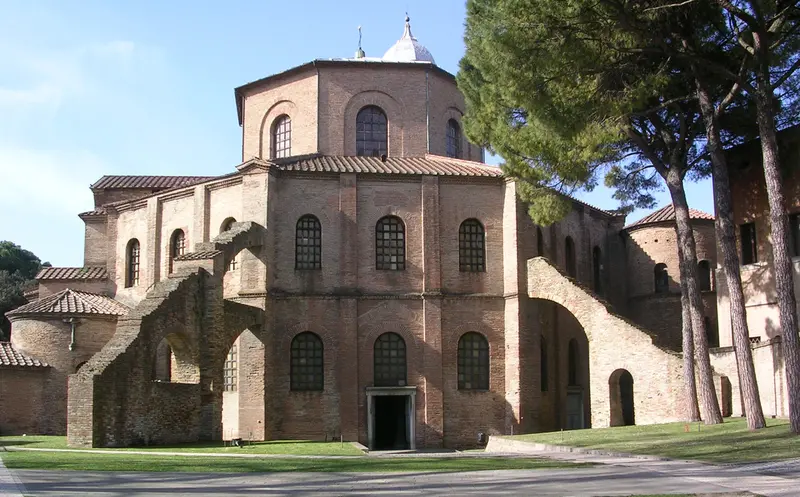
The most important city in Romagna, Ravenna is connected to the Adriatic sea by the Candiano Canal. In ancient times, it was a federated city of the Roman Republic, the port of Classe was connected to the Po Delta in the 2nd - 3rd centuries AD.
The city rose to prominence in 402, when Emperor Honorius chose it as the capital of the Western Roman Empire. After the fall of the empire (476), the Gothic king Theodoric kept it as his capital from 493. Later, thanks to Emperor Justinian, who made it a bishopric in the 6th century, the city became a driving force of Byzantine domination in the West.
A commune in the 12th century, it was ruled first by the Traversari family, of the Guelph faction, and then, in the 14th century, by the da Polenta family, who with Guido Novello gave shelter to the exiled Dante Alighieri who died there in 1321.
In the 15th century, it was under the protection of the Republic of Venice and, after the Battle of Agnadello (1509), under the Papal States.
Ravenna's most important masterpieces, however, date back to the 5th - 6th centuries: the mausoleum of Galla Placidia, sister of Honorius, originally annexed to the church of Santa Croce which has been in large part destroyed; the Orthodox Baptistery; the Arian monuments commissioned by Theodoric, such as the Arian Baptistery, the Mausoleum of Theodoric, and the Basilica of Sant'Apollinare Nuovo. The latter marks the transition to the Byzantine era of Justinian, who modified the church's mosaics, erasing the memory of Theodoric, and building the Basilica of San Vitale and the Basilica of Sant'Apollinare in Classe, the first in Christian history to feature a saint (the patron saint of Ravenna) in the apse, rather than Christ or the Virgin Mary.
Other noteworthy places in the city are piazza del Popolo, the centre of municipal power and previously of the da Polenta family; the Classense library, part of the ancient Camaldolese abbey; and Dante's tomb, adjacent to the Convent of San Francesco, adorned with a marble relief by Pietro Lombardo depicting the poet at a lectern (c. 1483).
Emilia-Romagna Film Commission
Viale Aldo Moro 38 — 40127 Bologna
Phone: +39 051 5278753
Email: filmcom@regione.emilia-romagna.it