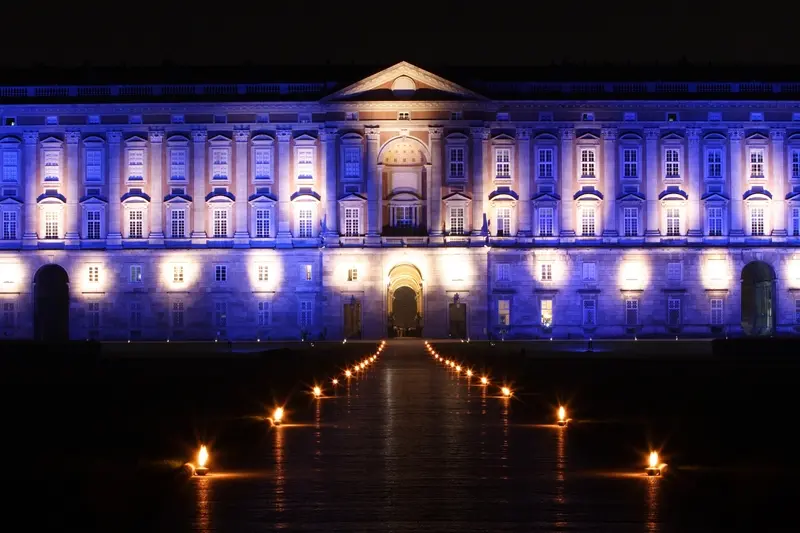
The modern core of the city of Caserta arose between the 17th and 18th centuries, just kilometres from the old city which is today a district known as Casertavecchia. The entire area was sold to the Bourbons of Naples by the Caetani family, who had acquired it in 1619 through their union with the Acquaviva family.
In the mid-18th century, Charles I decided to build a new palace inland, far from the sea for fear of a possible French naval attack and the modern city of Caserta developed around the new Royal Palace of Caserta, designed by Luigi Vanvitelli.
At the end of the century, King Ferdinand IV built another residence in the San Leucio area, annexed to a textile factory, with a belvedere overlooking the palace built by his father and the gulf of Naples. Here, the king built the neighbourhoods of San Carlo and San Ferdinando for the workers, where inhabitants were to enjoy economic equality and renounce luxury in a utopia that envisioned their livelihood as dependent on the textile factory.
Caserta joined the Kingdom of Italy, and became a provincial capital after WWII. In the decades of the economic boom, the city expanded to cover its current surface area.
In addition to the Royal Palace and the Belvedere di San Leucio Palace with its distinctive Bourbon arch, modern Caserta preserves the cathedral of San Michele Arcangelo, built between the late 18th and early 19th centuries by transforming the small church of San Sebastiano; piazza Dante, formerly piazza dei Quattro Canti, characterized by four porticoed buildings facing the Royal Palace; piazza Vanvitelli with the 16th-century Palazzo Acquaviva and monument to Luigi Vanvitelli (1879); and the Triumphal Arch of the Monument to the Fallen of the First World War (1935).
Film Commission Regione Campania
Piazza G. Bovio, 14 — 80133 Napoli
Phone: +39 0814206091
Fax: +39 0817904221
Email: info@fcrc.it